Hear Some Music I've Enjoyed...Randomly Selected for You
Talking Heads - Life During Wartime (Live) | Youtube Burn some serious calories dancing to this song and singing about vans that are loaded with weapons.
Eisfabrik - The Choice | Youtube

Talking Heads - Life During Wartime (Live) | Youtube Burn some serious calories dancing to this song and singing about vans that are loaded with weapons.
Eisfabrik - The Choice | Youtube
Scaling Functional Perspectives of Cognition
I’ve been playing with scaling modifiers to the new cognitive function extensions. The scaling modifiers are * and /.
Why these symbols in particular? Well, I already added plus and minus; My intuition tells me it would be fun to add all the other little calculator buttons, too, and this has been fun to think about.
Some people think you have to discover some hidden truth, and THEN you go adding in the symbologies.
But that’s boring. It’s more fun to reverse that process, and see what happens.
Here’s the Scale-up side:
O* would be the perception of the outsized potential of a given functional perspective, in a given context.D* would be the intensive command to engage the tools of a given functional perspective, in a given context.And the Scale-down side:
O/ would be the perception of a massive overengagement of the functional perspective, or a perception that its engagement must be massively decreased in order to achieve a good outcome.D/ would be the intensive command to disengage the functional perspective.Examples:
NiD/ expresses e.g. your single-outcome perception role is massively overdone given the problem we need to solve here, so stop being such a prophet of doom.FiO/xh expresses a question like “why is your skill at deploying relativistic relational logic so precious to you that it seems to prevent you from getting a good outcome in this situation?”This last example is a big part of what keeps good people in cults, I’ve found. Which made me think about the way strong and overused functional perspectives keep people stuck to things, stuck in things, and stuck on things.
Attaching a formal language to this could act as a grosso modo method of measurement and help offer control that could, potentially—and as an example here—help people to leave harmful cult enviornments.
Advanced Levels, or Making it All Easier
One funny thing about hitting the advanced level in personal study, or even in a lot of formal disciplines: Quite often, nobody pops up and tells you when you’ve arrived.
It may be that your first perception of the advanced level is a deep feeling of frustration with your work. That’s expected, in a way, but it’s also kind of a shitty trophy to receive. Congrats! Here’s a feeling of frustration. Wear it proudly!
Others might also have a difficult time telling you what to do when you get there.
It seems to me that a lot of energy is wasted because we teach each other to think of “Advanced” as “difficult,” without spending much time on why advanced is difficult.
Advanced levels are difficult because they present more subjective problems, for one. Here’s an example:
Depth is difficult because it involves things like reconciliation loops and a willingness to self-contradict. It’s also extraordinarily difficult to communicate from a place of genuine depth, not only because of the time taken, but because there is a subjective weighting factor in determining how others can metabolize a depth-based conversation. In other words: I could explain this to you, but is it worth the trade-off?
In some cases, yes, it’s worth it via contract, compact, or other means.
But in many cases, the explanation is left undone, and the student who was ready to go advanced was left to think “just as I thought, they don’t know the answer,” or worse, “there’s no point in going this deep—after all I’m pretty good at it and I can’t perceive any of the value this person claims to have perceived clearly.”
It would be nice to develop better tools to communicate this level of depth; as it stands now, language leaves a stunning inequity here that robs us all of the progress we ought to be able to make together.
And THAT would be truly advanced progress.
Academic Math
Academic math has recently been changing in character. It seems to have transitioned from deeply qualitative theory to something more akin to opportunistic application.
Some have described this approach as stringing together “black boxes” which are “assumed to work”.
Here you can watch someone “very important”, who communicates from Ne*, Ti+ functional perspectives, lamenting this change:
His sentiment is mainly NeO* as he chases after subjective psychological mandate. We all must deploy our heroic perspectives.
But it’s also a clear sentiment of SeO/ and TeO/ in a hesitant way. The cards are already laid out; the river has been crossed. You can read the resignation on his face—in regard to those functional perspectives, at least.
Let me do some spitballin’ here.
Math has come down to earth. It probably will do more grounding in the near future. You’ll see more math in your home environment. You’ll be able to set your home cooker to make or print you a formulaic steak, and you’ll know your favorite formulaic patterns by heart.
That’s right, I’m talking about direct formulaic inputs! It will be an amazing convenience and ordinary people will be tripping over themselves to learn some more of that math.
Even backwater types will be playing twangy music in the background in their videos instructing you on their home-recipe formulaic inputs for your next competition-level, single-shot .25 caliber AI-assisted duck hunt.
(Who needs a shotgun anymore, with this kind of access to precision?)
This is all going to bug pure-logic theorists, which is great, and sure, kinda terrifying too, but IMO it will lead to a resurgence of theory later, with a much more expansive space where subjective-organizational TiO* inputs will feel like rainfall in the desert.
Math may even transcend itself in 20 different ways with this kind of metamorphosis happening, for all I know.
Expectations:
OK, that’s enough for now.
A lot of people act as if keeping a lot of web browser tabs open is sloppy behavior. Or at the very least, amusing behavior. I don’t blame them; it’s become a bit of a cultural meme.
In the Google Chrome browser, you’ll see a laughing face icon if you open 100 tabs or more.
What’s a Tab, Really?
Personally I think this laughing face is a visual representation of a problem with the way we think about tabs.
Or: The way we don’t think about them.
To a lot of people, open tabs are “interesting stuff” maybe, or “stuff I forgot about”. The tabs themselves? Just tools. Memory-hogging tools even.
Our fears easily take over, and tell us they’re all clutter.
“Oh no, I’m some kind of data hoarder!” We reach for our most disastrous-sounding fear words.
Opening Tabs is Productive Effort, Even if You Think it’s Lazy
But: I’m here to tell you that opening tabs is work. And I think our minds recognize that—subconsciously, if not consciously.
Quite often, opening a tab is the result of research effort. For example, finding a book you read a long time ago, after finally remembering the title, or something other than the color of the cover.
Even if this is a comic book, or a children’s book, your subconscious mind may know its value better than you do. And the processes you used to find it may have been the same mental processes you use as part of your work day!
A new tab can also represent organizational work. Maybe it’s a workspace, like your favorite online code editor, mailbox, or the set of websites you need to review before you start your upcoming training.
Plus, a new tab can represent super-important progress on a big project that you know you’ll tend to put off again if you close the tab.
In this case, the tab that stays open does so because of analytical effort on your part. You analyzed your own behavior and kept the tab open based on probabilistic outcomes. Go you!
Tabs are Milestones
In some ways I think you could call tabs milestones and you’d have a better idea of what tabs represent, and why they are so hard to close.
Milestones involve positive emotion. They represent a path forward for you. Maybe that path forward involves re-reading that book you enjoyed, and getting your enjoyable lifestyle back into gear. Or maybe it involves completing the training that will surely lead to a promotion at work.
Keeping the tab open is important symbolically at the very least—the already opened tab is a symbol of part of you that is open, improving your life, or loving life, or seeing things in a new light.
A long strip of happy milestones along the top of a browser is, then, more like an accomplishment.
I think we should be proud of our tabs in a lot of cases. And browsers should help support this constructive practice and emotion. A laughing face doesn’t really help, and it may even hurt!
Tabs are Tombstones
After a while, the milestones often turn into symbolic tombstones. The act of closing the tab represents a form of death—but it’s more like death due to giving up, or turning away, than death due to natural causes.
Tombstone tabs involve negative emotion. Do we need more negative emotion in our lives? Do you? I don’t. Maybe this is why my tabs stay open longer.
The act of “closing tabs” can quickly become something like a mass-funeral. Sometimes we do the work to try to save tabs from this death.
Many of us have used third-party software or browser extensions to preserve the tabs we have open, and transition them to a specially-designated database of our own, for example.
Why do we try to preserve the tabs? Because open tabs are milestones along a longer journey, maybe. A journey that we don’t want to end. Likely for good reason.
So of course, this process is painful and it’s no wonder we put it off.
Preserving What’s Happy, Avoiding What’s Sad
With the tabs themselves representing THIS much sunk cost and emotional content…is it any wonder we humans can rack up so many open tabs, and feel so avoidant about closing them?
I think it’s only natural to find that tabs add up over time, even when we are constructively focused, and despite any fears about a loss of attention span.
This tab stuff is work! It’s progress! We all want to keep our happy progress, and prevent tab death.
Maybe more browsers could help us out with that part.
The problem of tab-tension, to say nothing of the false dichotomy of “reasonable tabs vs. too many tabs” is an embarrassing result of slow evolution in software design. The fact that humans feel blame for the resulting behavior is 100% wrong and unnecessary.
The browser can have its tabs back, and even the whole tab model back, but I want to keep my progress.
Filed in: Feeling /64/ | Energy /121/ | Essays /53/ | Therapeutic Practice /148/ | Productivity /120/
Here are some new cognitive function extensions I’ve been working on. The latest version is also symbolic:
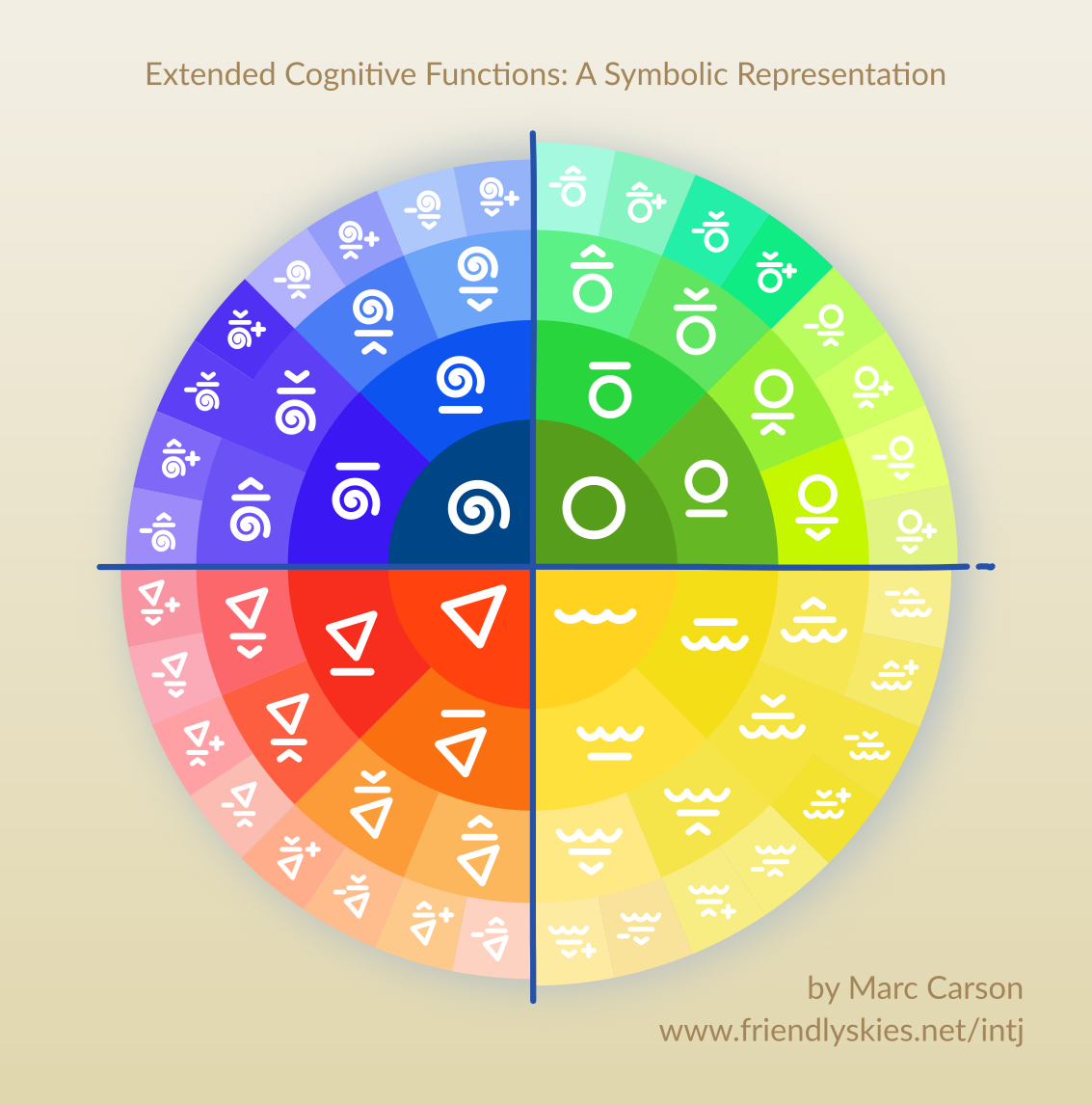
This model helps to catalog the cognitive functionality that anyone can access. It’s not really about what “type” you are, though it can help you transition from standard personality type to knowing yourself even better.
The four symbols are:
The underline represents introversion, while the overline represents extroversion.
The carat symbol indicates whether information is being directed / organized / created (upward arrow) or observed / taken in (downward arrow).
The plus and minus indicate more about the nature of the use of the function (more below).
Here’s the older version of the graphic, with the letters, for ease of reference:
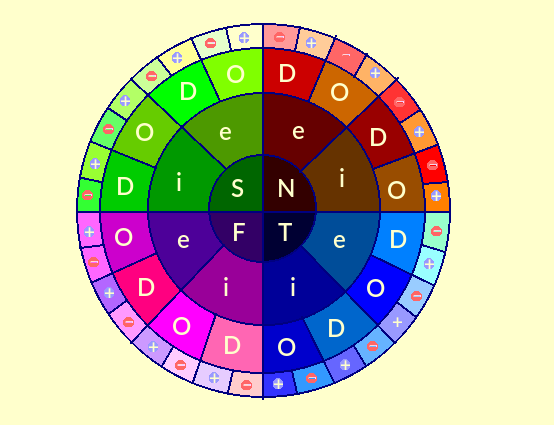
In terms of presentation this is really rough so far, but that’s mostly because it’s a fairly detailed model and it’s still first steps here.
New Suffixes
There are two new letter suffixes:
D: Directive use of the function (upward carat or arrow). Involves directing, cueing, or otherwise emphasizing changes that are to be executed.
O: Observant use of the function (downward carat or arrow). Involves observing, noting, or otherwise emphasizing things that are observed/sensed/perceived.
In this model, “Judging” functions T and F can be used for perception, and “Perceiving” functions N and S can be used in judgment (directive) tasks. I feel this more accurately describes the use of these functions in normal conversation.
There are also two other suffixes, the plus and minus:
+: Positive or constructive use of the function. Emphasizes things you should do or will do for positive effect, or that are happening / will happen / have happened for positive effect.
-: Negative, critical, or destructive use of the function. Emphasizes things that should not be done, or will not be done, or that are happening / will happen / have happened for negative effect.
Question Symbols
Since questions come up a lot in speech and thought, I’ve designated ‘x’ as a question mark substitute (borrowed from Gregg Shorthand). The x is written in lowercase unless it is denoted as subscript, in that case it would be capitalized. Here are question-type-specific notations:
Where is my car? SeO+xr
Why did your friend come so late? TeO-xh
What is the meaning of this black feather on my pillow? SeO-xh
What is the meaning of life? NiO+xp
What could life possibly mean? NeO+xp
I went by mom’s house today and found this old cassette recorder. I think it will fit our plans perfectly. Do you like it? SiO+ —> SeO+ —> NiO+ —> FiO+xh
There is a lot of room for argument as to which functions are used here. I think of this as more of a Lego-like language, or a language for inspiring more questions about people, instead of a precise replication language. So you could even simply say that the example here concerns an issue of NiD+xp, or what we ought to do to achieve a future outcome. But it would be even better to actually ask the subject about that—to what degree does that conclusion seem true to the subject?
I’d rather use the terms to ask questions or stimulate thinking, than to delineate sides in an argument. Each viewpoint may have its own unique leverage. Hold your models lightly…
For Best Use
Below I’ve written up the entire group, providing examples where possible:
- Ne: (Extroverted Intuition)
    - Directive D+/-
        - + Get everybody to contribute their ideas. No idea should be considered unworthy or dumb!
        - - Don't do it the old-fashioned way unless you want old-fashioned results.
    - Observant O+/-
        - + Air traffic can be compared to fish swimming in a river.
        - - You're stuck on all these old ideas. Let some creativity in!
- Ni: (Introverted Intuition)
    - D+/-
        - + Buy this stock today and you'll likely triple your money by this time next year.
        - - CONCEPT (Contingency) Don't rent an apartment within earshot of that railroad track or you'll hear trains all night.
    - O+/-
        - + CONCEPT / Future: In the future people will live more like animals, but in a good way.
        - - METAPHOR / Now: The person running the hot dog stand is a real snake.
- Se: (Extroverted Sensation)
    - D+/-
        - + Jump up and down a few times, it'll get you warmed up.
        - + To be an impressive person in this group I ought to wear a really new set of clothing.
        - - You'll be misunderstood if you frown like that while dancing to happy music.
        - - Don't speak so quietly. People will never notice you.
    - O+/-
        - + The loud music makes me feel alive.
        - + This food is fresh.
        - - This cassette player is old.
        - - That person is getting all the attention by laughing loudly; everyone is looking at them.
- Si: (Introverted Sensation)
    - Directive D+/-
        - + Emphasize our traditions in your talk to the new employees.
        - - Don't ignore my important dates and family traditions or we can't be together.
        - - Don't put those two foods together, that's disgusting. PB&J has no "A" for apples.
    - Observant O+/-
        - + We used to sit under this tree and eat those yummy pastries together, remember?
        - - That's not how things are done around here. We have been in the business for years, so don't argue until you know the ropes.
- Te: (Extroverted Thinking)
    - Directive D+/-
        - + Count your calories and you'll lose weight. Measurement yields control.
        - + I should start that project today so I have enough time to finish it by the end of the month.
        - - Nobody does things that way anymore. It's totally dumb.
        - - Stop completing your work so late.
    - Observant O+/-
        - + Using the new system, our profits went up by 20% and we did 30% less work!
        - - You made us late again. How is it this hard to get to work a few minutes early?
- Ti: (Introverted Thinking)
    - Directive D+/-
        - + When you get to Level 2 of the game, go into the first door on the right and push on the right side of the bookcase.
        - - Stop telling that person you disagree with them, if you want them to like working with you.
    - Observant O+/-
        - + If you take two away from a group of three, you get one.
        - - It seems like a dumb idea to walk on the oncoming-traffic side of the road if you don't want to get hit by that oncoming car.
- Fe: (Extroverted Thinking)
    - Directive D+/-
        - + Always thank the person who introduced you before your speech.
        - - Ditch that loser and move on with your life.
    - Observant O+/-
        - + Everyone on the team is united under the noble principles of our cause.
        - - That person has horrible breath and wears tacky clothing.
- Fi: (Introverted Thinking)
    - Directive D+/-
        - + You should talk to people and get to know them better, even if you know they could hurt you.
        - - Don't accept public praise and rewards that you privately know you don't deserve.
    - Observant O+/-
        - + I value relationships that are co-creative.
        - - I don't like it when people make fun of others who are in vulnerable situations.
Note: This model does include plus and minus, which I think I’ve mentioned before are also used in at least one Socionics model, but the use there has varying characteristics and I am treating my pluses and minuses here as distinct. Kind of like the way the letters can mean different things depending on the model, even if the models use the same letters.
Filed in: Ni /42/ | Publications /44/ | Ne /17/ | Productivity /120/ | Thinking /71/ | Control /112/ | Fi /35/ | Si /19/ | Feeling /64/ | Fe /20/ | Socionics /7/ | Te /36/ | Sensation /40/ | Therapeutic Practice /148/ | Intuition /63/ | Se /25/ | Ti /30/
Cherie writes,
I was reading about your view of interests and hobbies. I know some of my friends don’t like hearing this because they are so dedicated to everything, but I don’t like spending money on hobbies, especially new ones.
I wanted to call this point out a bit, and underline it: I agree!
Sometimes it feels like there’s a LOT of social pressure to upgrade one’s approach to a hobby.
There’s also internal pressure. I think INTJs can really understand this vulnerability with a bit of awareness. For one, we may find ourselves in the passionate-ESFP zone with hobbies:
Even in really geeky hobbies, there’s all this amazing gear. You name the hobby, and there’s the high-end of it which, yes, hobbyists are buying into.
And then there’s the passionate-INTJ zone backing this up, like:
Personally, I’m very familiar with this way of looking at hobbies. And even though I still find myself thinking this way, it has also lost a lot of its appeal to me.
I wanted to share an experience that I think demonstrates why…or how…
Here, I Just Upgraded Your Hobby for You
A while back I was participating in an online EDC community. It was fun to share little items, pocket stuff I enjoyed bringing along on a hike or on a trip or whatever.
And one of my relatively new hobby rules is like this: I go cheap and broad with new hobbies, rather than expensive & deep.
So instead of buying the best item in a category, I’ll buy a few good-enoughs at 1/10 the price, and explore how they work differently, learning the ins and outs and the leverage points of each. I found that I like this better overall.
I often find that I like the color of cheaper items better, or they fit my hand better, and they are otherwise good enough or even overkill for what I’m doing.
This led to me sharing a photo of some EDC items, including a knockoff pocket knife. It’s a really pretty blue color and I enjoy it. I also liked that I scouted it out online, like a hunter, finding that perfect medium—the right color, an amazing price, and well-reviewed by a few people who knew the topic deeply.
I got some nice comments from the community, but then really soon after that I received an offer—someone said they wanted to send me the expensive, proper, branded version of that very knife! It’s not cheap, not by a long shot, but they said they had an extra that they would be happy to part with.
In the mail, a few days later, I received TWO branded pocketknives, and a very nice pocket flashlight. And not used at all, but shipped direct from an online store, and in complete original packaging, with a receipt. This person spent a lot of money on a stranger. I was grateful. (I told them I’d pay it forward, and I did)
The Mystery of the Internet Patron
But then it got weirdly complex, thinking about what happened.
What IS it about this situation? It started to bug me.
It was a really nice gesture. But also, thinking about it as I sat with all this brand new, expensive gear in my lap, I had to conclude—it felt VERY awkward.
I could tell that the person who sent me these things was very passionate about their hobby. They clearly wanted other people to also reach, or see, their passion-pinnacle.
But for me it wasn’t that kind of interest.
I have to say that the passion I felt from this generous person went a bit beyond normal and into the creepy zone.
Not that they themselves were necessarily acting super creepy.
But that it reminded me of my own creepy-passionate aspects.
And memories.
Can You Give Away A Passion for Free?
That was it!
It reminded me of this time. Way back, years ago. I moved to a faraway country, and I knocked on tens of thousands of doors.
(Not to brag, but: I can mimic the sound of a 1990s Japanese doorbell running out of its final few seconds of battery power.)
(Well—and I can also mimic the sound of a Japanese housewife being sketched out by the sight of a tall American in a $1 necktie, soaked from head to toe in typhoon moisture and happy to be off the road for now, sorry, moving on to the next door)
I was out there making free offers. With passion.
I’d offer to give people free books out of my backpack, teaching them the mysteries of the universe that science had missed.
And if they didn’t want the free book, how about this free English class?
Or how about a free prayer…?
Well—free for now. From me, it’s free. Yep.
But later, truth be told, if you really get passionate, there’s some really amazing stuff you can spend money on.
Personally I ended up spending 10% of my yearly income on that particular passion project, and even more money than that, as I explored many sub-hobbies within it…for years…
Passion Energy Makes Me Want to go Cheap Sometimes
Passion energy is really amazing. It feels like it ought to be more infectious than it is. It also feels like it should be free.
Here, try some! Isn’t it great?
But it’s kind of scary, too. It can lock you up with backlogs full of meaning or conflict to dissect later on, not to mention the resource-consuming energy highs and energy lows.
So I think that’s why I end up going cheap, for fun. If things don’t have to be that serious, then I don’t want to send my future self any kind of signal that overdoes the passion and makes everything just way too much.
I think that’s also why I abuse this blog a bit, in the sense that I aim for a less-than-passionate outcome.
Quite a few readers have sent me ideas for improvement, awesome suggestions, feedback. All appreciated—they tell me about your interest, for sure.
And yet I have to admit I don’t wanna summon the level of energy required. Not that I’d hate the outcome. But…you could say I don’t want it to be that passionate of an activity.
I want it to be cheap, broad, shallow in its own way.
I’ve probably come to be terrified of passion, at a very deep level. Or at least, key aspects of passion. It’s serious biz.
How about you?
Filed in: Energy /121/ | Relationships /78/ | Interests /112/
I was watching some Smarter Every Day videos lately and I got this really sudden, strong INTJ-intuition. Is Destin an INTJ? Maybe!
It’s a fun video. Very little poop is involved. Destin is doing a demonstrative variant of taking the manual writing character bonus for INTJs.
(Note: I have been aboard a nuclear submarine myself, walked among the missile tubes, and it was a really neat experience. Also, I did look behind the curtains like any curious person might, and I saw a bunch of statistics that I don’t remember, and yes, the curtains were shut really fast when somebody caught on. They were pros about it though. Thanks US Navy! I won’t forget all the ice cream I ate on ur boat)
Also. IMO Linus from Linus Tech Tips rings my ENTJ bell, and here they are together for people who have asked me about ENTJs on Youtube.
I hope you can see the way Linus’ extraversion energy is effectively L I M I T L E S S by comparison. In contrast, Destin is much more introverted/subjective and incorporates himself at a deeper level, but I think he does it in a really graceful way. He also goes into some really cool little factors in his videos that Linus would probably swat away like annoying flies.
Linus has also been observed doing some risky Ni stuff before, like proclaiming the one-certain-meaning-to-this and calling a product or situation a disaster before he really knows what’s going on with the details. My hope for anybody developing Ni is that they can move beyond this “we’re f***ed” stage as quickly as possible.
I do see Linus’ Te really pushing Destin into the Fi box during that video; anyway it’s no big deal and it’s cool to see them together. Always something to learn…no space for emotional drama here, nope…k back to work and learning everybody…lol
Just to balance things out, here’s an observationally-ESFP I like to watch sometimes.
All clear in sector seven!
Jesse writes,
…I had a pretty big life-changer experience. I always wondered where my exhaustion/anxiety and depression came from. I didn’t feel they were inborn; that they were just symptoms of a systemic problem.
Turns out I’m a clinical perfectionist. Learning this has been massively relieving. I gander many INTJs struggles with this. Probably any high-achieving personality type.
This video really opened my eyes. I’m reading Overcoming Perfectionism now. I feel 100 pounds lighter.
Thanks Jesse for sharing your experience and the video. And way to go! I’m really happy for you, you deserve it all and more.
Jesse’s email made me think about where perfectionism fit into my own journey.
Thoughts on Perfectionism
I remembered that for me, perfectionism was by far the worst when I was working in xSTJ business environments where A) rules governing employees were valued over output, and 2) my own subjective values were not appreciated or demonstrated.
It’s been a while since I’ve been in that situation though, so I’m not sure how it would work out these days. I’d like to think I could go back and really push back, but who knows. Groups are powerful and self-protective.
And that’s a circumstantial example. I think circumstances really matter. We humans like to think we can “fix” things but sometimes that’s a really dumb notion.
Getting out of those circumstances (i.e. quitting both positions and moving the f*** on with my life) almost instantly “cured” my perfectionism, including weird things like a speech impediment I was starting to develop! It’s a memory from long ago that still makes me shake my head.
However, there are certainly a lot of strategies that have helped when I get into more of a perfectionist mode. These have helped me from falling into the same old traps over and over, even or especially when working for myself. So here we go!
Other Strategies
Off the top of my head, some things that helped me deal with perfectionism in general:
That’s all I got for now…plus you guys know how this blog works (high-volume slop first, fix later) so you get to see me actively trashing perfectionism with every chance I get. We are FAR from perfect here.
Hope it helps!
Filed in: Anxiety /32/ | Careers /40/ | Productivity /120/ | Procrastination /23/

Get your spy music ready for today’s post…
Just some stuff I’ve been working on lately…let’s do the (kinda?) boring stuff first!
Text Editor Journaling for Productivity
I just published a video showing some of the ways I journal for productivity using Geany:
There’s a ton of stuff in here really, so I think the video maybe looks more boring than it is.
Or…I REALLY hope so.
Random Workouts
Here’s an article with a list of random workouts and some methods for selecting one.
I’ve been using it for the last week and it’s been pretty fun.
I usually roll a few and then pick the one I like.
Secret Agent Roleplaying: SIFT-CADS
Here’s the skeleton of a new tabletop roleplaying system I’ve been working on. It’s meant for games with that James Bond vibe.
To keep it simple, the mechanic is D100 based, roll-under percentage. So if you are 75% good at something, you try to roll at or under 75. With some modifiers as specified below.
Assign these scores to your character in any arrangement: 25, 25, 75, 75, higher is better.
(Do these look familiar…?)
Facets help you determine what kind of character you’ve got on your hands. More mentally prepared, more physically-focused, more charismatic, or cold and logical?
And yeah, one of the lowkey goals of the game design was to see if I could integrate the various personality functions.
Attributes are like special weapons the character can deploy at any time. To really get the most out of a super spy, a good player-character will use a mix of these in every adventure.
When the player uses these, they are allowed to change the scene, and the GM defers to character prerogative or tries to accomodate the player’s changes. (Some negotiation over this is OK) A player can use each Attribute once per basic adventure, for a scene change and automatic roll-at-or-under 75 to get the result.
Skills provide an extra 10 or 20 points to the high-end goal of any Facet roll. So if you were rolling under 25, it could be increased to 35 or 45. Distribute 100 points for first adventure.
That’s it for now…enjoy the weekend!
Filed in: Therapeutic Practice /148/ | Interests /112/ | Productivity /120/
I’ve noticed this pattern among my ENTJ friends:
…they sit in a huge recliner to work, like Louis does.
(I have to admit it makes me laugh, sorry but that huge friggin’ recliner is straight out of my grandma’s house, not that I’m some exemplary furniture guy, but there we are)
Now, we could call this the cringe-inducing influence of tertiary Se, for example. And there are some funny things that jive well with the child-like Se-positioning framework. I mean, some of those same friends also eat kids’ breakfast cereal in the morning, their diets are absolute crap, and it’s hard to take somebody serious when they’re inviting you to conquer the galaxy with them while spilling milk on themselves as they try to reach the recliner adjustment on the side of the friggin’ huge chair.
However I have to admit I am kind of coming around to this recliner thing.
First, laying down for work is admittedly pretty damn nice. I do this all the time and end up laying in bed and getting WAY more work done than I thought I would.
(I always have to straighten up the room when I do this, I need at least a three-star museum-quality bed setup, pick things up and straighten out the blankets, or it all just feels so wrong)
But reclining is also really, really comfortable for long periods. It doesn’t require as much bed-pillow adjustment for example. I do use a lumbar pillow now, because I hate being slumped over when I sit up.
I’m browsing around online, considering all options, including a “gaming recliner” which is somehow just a hilarious combination of words to me today.
And I’m tagging this under Fitness, because I get this funny intuition-itch that tells me that sitting in a lazy position all day at work could support a psychological craving for athletic activity later! You never know about this yin-yang stuff.
Anyway. Tune in next time, as I live-blog from one of those hot new custom gaming caskets!
Filed in: Therapeutic Practice /148/ | Se /25/ | Fitness /31/ | Productivity /120/
I added Stephen Wolfram to my list of people I would say are, observationally, INTJs.
I thought a lot about this one. But as of now, I have to conclude that the nature of his thinking is extremely subjective-intuition-driven (Ni) and even stubbornly so. His language is fundamentally visual-metaphorical (watch his gestures and descriptions), which is also an important sign of Ni-basing. And his career keeps coming back to patterns where this intuitive foundation mixes with utter pragmatism and business logic (Te).
There were also some early life & career missteps that seemed more fundamentally INTJ than any other type.
I think that’s the best way I can put it, for now.
Other candidate personality types were: ENTP (I’d say maybe 15% chance based on the reading / watching I’ve done so far), and INTP (5%).
There are some aspects of his use of experiential recall, Te-constructive work over long periods of time, and extraverted intuition that intrigue me. But not enough to distract from my main conclusion. These could easily be family- or environmentally-influenced, for example. Even the fact that one has an audience, or a “social persona,” could be enough to virtually mandate the use of various extraverted personality aspects.
To some degree there’s a bit of a vulnerability or weakness involved in admitting one can be wrong about guessing someone else’s personality type. But I like to lean into that. I have been wrong before, and being wrong about stuff is an important key to learning about personality, and many other things.
The Why
Why do this list-making with personality types?
One reason is that it helps me explore my own interests at a deeply effective level. For example, if I’m interested in math, science, or physics, it may be easier for me to learn Wolfram-the-INTJ’s theories first, and add other challenges later, than it is to learn Einstein-the-INTP’s theories first.
With an INTJ’s “unification-style” theorizing done up front, it would tend to be much easier for me to dive into the “separation-style” theorizing done by an INTP, because I can better see where their discrete, separated-style works fit into the big picture of the theory.
I can test this in a simple way by reading through their materials, and in many cases this has proven a very helpful method for picking up new skills, or just learning new things.
So today the Productivity tag on the blog hit 100 articles. I’m pretty happy about that. If you are interested in being more productive, there’s probably something on that list that will help you out.
Writing about productivity is pretty easy for me, because personally, my psychology is continually showing me future-stuff that needs things done about it. It’s the contingency planner psychology, and I’m stuck with it.
For example, a thought comes in: “Hey, it’s been a rainy month so far, and this means the locks around the house will probably start to corrode like they did before, and that totally sucked, so probably get the WD-40 and spray them out.” So you make a plan to find the WD-40, or to buy electronic locks, or whatever.
There’s a constant stream of this stuff, and it feels good to be able to address at least some of that in a timely manner. You can’t do it all, but you can do some—and there’s the trick! Which items do you do, and how much, and how well? And how do you generally do a good enough job at keeping up with this stuff? Is there a system that can be used, to make everything a little bit easier?
Upon reflection, a few secrets:
First, one big secret of productivity systems is that you gotta have a next thing. Something else to try. Your current system has a countdown timer attached, in a way. It won’t work forever.
Maybe you’ll come back to it again someday, but sometime soon, your current system will probably start to feel much less effective.
This is why I designed my own system, Task BATL, to be modular and theory-based, rather than monolithic and routine-based. You can rearrange it and the way it works. You can use it backwards and make it look more like play than work, and sometimes that’s what you need…
So my Second secret is that productivity has a deep and dark shadow. There is a yin to its yang, so to speak.
If you want to be productive, you need to master this shadow. You need to be able to be lazy, motionless, and relatively unaffected by time pressure.
This is always easier at some times than others, but I find it works best when you’ve got something to watch, or listen to, or feel (like floating in a pool).
Doing this builds up important energy capacity that you’ll need later, when you are checking things off your list left and right.
Finally, my Third productivity secret is that productivity should be relatively shallow, if it is going to be frequent. You should establish a “maximum dive depth” on a project, and have an idea of just how much work you have to do.
If you find yourself getting deeper and deeper into a project, and the project will last for more than a day or so, make plans to pause your work ASAP. Use the rest of your energy to “put a handle on the work for next time” (write down what you were doing, and how to pick up the work again), before you burn out!
Ideally, you’ll be able to make plans to pause your work before you get started. I find this (bonus tip) is really helpful in a lot of cases.
Speaking of which…that’s enough blogging for today. Take care everybody! :-)
Filed in: Productivity /120/ | Control /112/