Here are a couple of INTJs worth knowing about: Kuba and Noah Anglin, brothers who, as high school students, built a fusion reactor inside of their home.
One of the most powerful aspects of personality type study is the revelation of the “healthy personality model,” or the idea that type gives you insights into the completed, individuated self. Research into the development of your own personality type can give you powerful glimpses of a potential future you. Research into all types can help you isolate additional areas for personal growth.
This is all part of becoming your best self—attacking day-to-day pitfalls like depression and boredom by discovering and exploring who you are.
By studying the INTJ and comparing myself with the “typical” INTJ preference set, I found areas where I was not using powerful gifts. Bringing those gifts into play allowed me to lose 35% of my bodyweight and accomplish other huge life & work goals.
Look over the following list: Who do you know, of the various types? What can you learn from them? Who do you want to get closer to, and observe more closely?
These are in rough order, from what I consider most powerful models, to perhaps least-but-still-useful.
Please note that not everyone’s the same, and your experiences in comparing your strengths and weaknesses to others should be weighed and judged just like in any other decision-making process.
The Models
1. Being More Like A “Typical” INTJ
It might seem unnecessary, but lots of INTJs could use improvement in this area. Before looking to other personality types, it’s a good idea to make sure you’re really in control of your natural gifts.
In what ways are you personally different from the “typical” INTJ? Can you open your mind to that difference, and explore INTJ-ier ways of doing things, even if you feel you’ve already experienced them in the past? Read up on the cognitive functions. Dario Nardi, an expert in the field of type, suggests that INTJs develop, after Ni and Te, Fi, Se, and Ti.
Understanding Te and setting up a “life improvement journal” & personal goal-tracking spreadsheet for the first time helped me lose a huge amount of weight. Understanding Ti helped me learn to procrastinate less and accomplish more with my time by creating helpful mental models and frameworks.
Let’s also break down the INTJ’s four-letter personality type code:
I is for Introversion. Is there a way to make my environment more introverted to support my needs? Do I need more quiet time to think? Am I under too much pressure to act now?
N is for iNtuition. How can I consult my intuition more often? If I imagine the solution to my current problem, what comes to mind first?
T is for Thinking. How could I measure my progress in solving this problem? What checklist items would get me to where I need to be?
J is for Judgement. Am I sitting back and “imagining” too often? What is an executive action measure I could take right now that would instantly get me going?
By behaving more like an INTJ, you tune into your natural gifts. See if learning to act “more on type” in this way gives you more leverage over your problems.
2. Being More Like A Spouse, Partner, Friend, or Close Family Member
In Awakening the Hero Within, Carol Pearson writes that our closest relationships give us hints to the ways our subconscious wants us to develop. The important differences between your personality type and your partner’s, for example, may account for your inner drive to spend time with them.
Ask yourself what impresses you or draws you to that person. Do you need to be doing more of that in your own life, personally? Start practicing it, and keep notes on your progress.
Emulating others’ best qualities is a great way to become a more mentally and emotionally independent person.
3. Being More Like the ENTP Personality Type
This is pretty fun for INTJs. ENTPs usually have a lot of fun with the sorts of subjective thinking that can really help INTJs. By “subjective,” I mean “my ideas”—what are your personal theories or observations on things? Can you gradually build and refine those theories as a way of gaining great leverage? As you observe a problem unfolding at work, what are the factors that are always present?
Or, if you had to invent an acronym to model a solution for a common problem you confront, what would the acronym be? As you gain more experience, keep an open mind to changing the acronym as needed.
Here’s another thing you can try: Take a journey, just on the surface of a fun or interesting topic, without diving in too deep. Last weekend I had a “Star Trek” weekend and caught up on some things I like about the Star Trek franchise. Then I designed a planet to which I’d like to travel. When I got bored, I moved along rather than forcing further development of the planet’s characteristics.
Conlangs are another area where you find lots of ENTPs. Ever tried to invent your own language? What’s a simple way you could start, without googling an “approved process” for doing so? Subjective thinking means finding your own way through a process, without letting others do too much of your thinking for you.
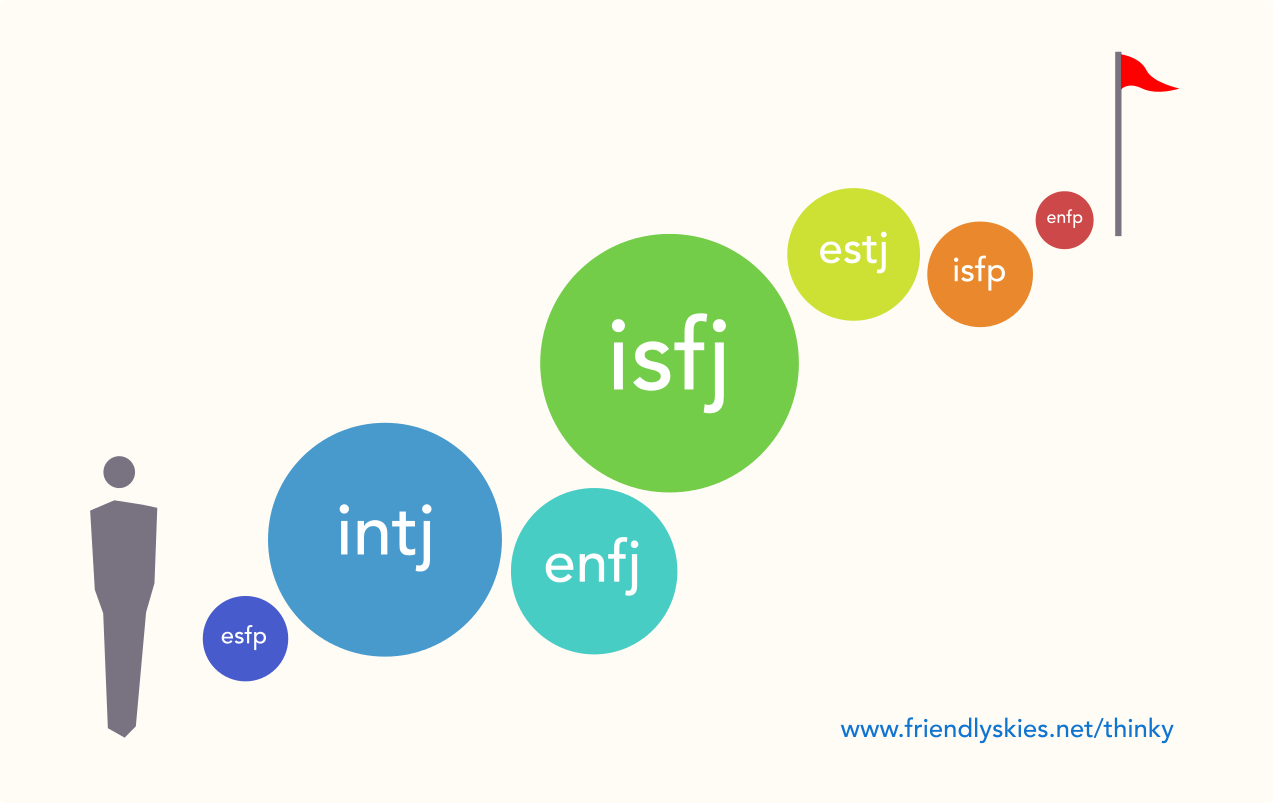
4. Being More Like Older INTJs, or INTJs who are more mature or further along than you
This is one of the key mentoring pairs for INTJs. Older INTJs are basically further along the same general path that your life will take. This is part of archetype theory, which Carl Jung developed heavily.
INTJs are typically similar to the “sage” or “magician” archetype. Some research here may save you trouble later on in your life.
Personality development is like working on a mandala, in that some themes may repeat again and again. For this reason it’s crucial to keep your mind wide open when studying under another INTJ. Try everything and don’t just say “I already know that” or “I’ve done that before.” Remember that themes will repeat but the outcomes usually differ.
5. Being More Like the ESFP Personality Type
INTJs tend to under-emphasize or even hide a relaxed, playful, lives-in-the-moment, upbeat personality. But it’s a very nice fallback for extremely stressful times.
We also, and maybe especially, hide a lazy side. People who constantly push themselves toward self-improvement aren’t generally happy with how productive they are in the first place. So sometimes we need to understand that part of our life-system just has to include laziness, and not so much “doing stuff”.
If we don’t give ourselves permission to recuperate and be lazy, sometimes the extreme stress can be observable in e.g. binging behaviors, sensory overstimulation, partying all the time, acts of child-like immaturity, etc.
Try asking yourself every day: “What do I want to do today? What sounds fun and interesting?” You might even find that it helps you to consider those things before you consider the things you have to do.
Seek other methods of interacting with and impacting the world. For example, would it feel good right now to have an office dance party? Or to give a child a high-five? Or to dive into a swimming pool? “Make it happen,” one of my ESFP friends would say.
6. Being More Like the ISFP Personality Type
The ISFP holds an important key in their ability to wield both the strong values system of introverted feeling (Fi) and the life-in-the-moment attitude of extraverted sensing (Se) in what becomes a very laid back, easygoing persona.
INTJs who can learn to develop Fi are more likely to feel that they know who they really are. They feel comfortable in their own shoes, and don’t need to be someone they’re not. They do things they really want to do, rather than getting sucked into a focus on things like material wealth.
INTJs who develop Se are immersed in and active in the present context. They are open to taking risks and understand what it means to sometimes let things flow without planning.
7. Being More Like the ENFP Personality Type
ENFPs have an amazing ability to take in only the most necessary, surface-level information while keeping their minds open to many different types and sources of information. Conversely, INTJs sometimes dive too deep and can’t make out the forest from the trees.
Have you ever worked on a project, only to emerge from it and realize it’s not necessary anymore? ENFPs also have a strong sense of “what I wanna do” and “what I don’t wanna do.” They take life by the horns and deal with problems as they come up by referring to an internal values compass. Sometimes INTJs need this compass badly, but only use it in a black & white manner. Remain on the job or quit; spend the money or save it; be best friends or be no friend at all.
ENFPs also harness a powerful idealism that directs them to change the future and move toward a more harmonious, creative, engaging, exciting world. When INTJs learn to see life through this lens, it empowers them to bring about great change and be larger than life in ways that benefit others.
8. Being More Like the INFJ Personality Type
INFJs are deeply intuitive people who are highly attuned to the feelings of the people around them. The INFJ usually knows intuitively that they need to seek group permission in order to make progress with a group, and group permission is not always established by “expertise.” “Expertise is all it takes” is a common INTJ stumbling block, so we INTJs can really learn from INFJs here.
Watching an INFJ in action, INTJs can learn how to successfully deal with input from others while doing what’s necessary to maintain good feelings.
INTJs can also learn from INFJs how to trust the intuition and listen to its sometimes-irrational suggestions. Trusting intuition, even if it can’t be easily explained, can be crucial in a decisionmaking process. Learning to be guided by metaphor is another important practice in this realm: What do you need to be right now? A rock? A river? A cloud? A battle tank? Ask your intuition what it suggests, and be that thing.
9. Being More Like the ISFJ Personality Type
ISFJs are the epitome of the “helper.” This can be helpful for INTJs to observe, because INTJs sometimes tune out of a situation right when their help is needed most. INTJs sometimes believe they’ve “explained everything,” but often what people need is an activity partner, someone to walk through a process with them and be a little bit more patient. This is not a “skilled or unskilled” question, but a true psychological need. By paying attention to this need, INTJs can be more effective friends, parents, and workmates.
ISFJs stay in the current context and make sure all the details are taken care of before they move on. They take delight in knowing they helped fulfill others’ needs. If INTJs can learn to do this AND be sensitive to others’ feelings and input, they can gain a lot of respect from those around them.
ISFJs are also sensitive to what’s fair. When something’s not fair, they often complain rather than just absorbing the injury the way an over-introverted INTJ might. Where an INTJ might say, “well I signed the contract, so I’m screwed,” the ISFJ says, “that’s what’s in the contract, but what’s fair?” They can often renegotiate in a very powerful way, based on simple details that simply need to be straightened out and communicated.
Finally, watch how your ISFJ friends exercise and preserve their health. While lots of INTJs are into hard-hitting martial arts, or fast dancing, or heavy weightlifting, or even acrobatics, an ISFJ will naturally understand how to maintain their health in a simpler, gentler manner. Sometimes a brief walk is just the thing to put you back into control over your day. At other times, maybe you need to take a long bike ride, canoe down a river, or enjoy a peaceful picnic next to a favorite lake or river.
10. Being More Like the INFP Personality Type
INFPs are often more outwardly patient than the INTJ. The INFP may have a less rushed point of view regarding things like business decisions.
INFPs take objective, measurement- or evidence-based thinking to the max, often showing INTJs exactly how much additional information can be gleaned and brought to bear in a project.
INFPs also like to work toward the best result, rather than the satisfactory result that INTJs often aim for. For this reason it’s a good idea to watch the way INFPs deeply care about process and making or changing decisions as things unfold.
11. Being More Like the ISTJ Personality Type
ISTJs don’t like to let things slip or coast for too long without bringing them back into line. They are typically amazing at not procrastinating, even if they can be pretty harsh on themselves in this area. They’d rather take a moment and prepare for an event a few months down the road, than put it off for another couple months.
INTJs can learn from ISTJs that by taking action now, it’s easier to support an organized lifestyle. INTJs can also learn that it’s OK to have fun little side hobbies that don’t “mean” anything in particular. It’s also OK to learn to keep and display a nice collection of one’s favorite little objects or possessions. INTJs sometimes cycle between “I have a messy space with lots of little objects scattered around” and “I threw it all away, I’m a minimalist!” Learning to build and care for a collection of things can be a powerful, joy-giving skill that transfers knowledge and facility into other areas of life.
12. Being More Like the ENFJ Personality Type
The ENFJ can open doors that may be shut to the INTJ, by combining their subjective framework-creation skills with their ability to harmonize and empathize with others. While ENFJs are often quick to try to teach INTJs their ways, this can put too much pressure on an INTJ, too fast. For this reason I recommend that INTJs study ENFJs from afar, model their behavior when it seems appropriate, and occasionally try to read books written by ENFJs. Survival Games Personalities Play is an excellent personality type book by ENFJ Eve Delunas.
13. Being More Like the ENTJ Personality Type
ENTJs are excellent early adopters. They usually have the newest gadget, or book, or whatever. Conversely, the INTJ often derides or complains about the latest gadget and may favor the old way, which they contend never went obsolete. As we watch ENTJs we can find a healthy way to respect the views and needs of others where things like technology are concerned.
ENTJs see negotiation as part of life. Anything can be negotiated! And, most crucially, anything can be negotiated without getting upset. ENTJs are often known as extremely kind, giving people, despite their reputation for mental toughness.
14. Being More Like the ESTJ Personality Type
ESTJs are constantly seeking to organize and get on top of things. They are usually conservative with resources (like time and money) and judge success by efficiency.
A healthy ESTJ can show an INTJ many ways to be conservative and effective at the same time. This often starts with a status question: “Where am I on that project? What do I need to do next?”
15. Being More Like the ESTP Personality Type
ESTPs are great at diving in to work on the key leverage points right now. Other details may not matter at all!
ESTPs are also great at paying attention to competitive differences that count right now. In a competition, ESTPs often ask themselves: “What would be totally awesome?” and they do it.
Throwing your weight around when needed, but with “all due respect” to cultural or contextual roles—the healthy, culturally necessary aspect of paying lip service, is another ESTP specialty. Sometimes INTJs think they’re too good for respectful or honorary language. It’s true that we’re all just humans, but respect for cultural or contextual roles is a crucial part of the human success framework.
15. Being More Like the ISTP Personality Type
ISTPs are fantastic at mentally taking things apart and puzzling their way through logic, new concepts, or physical things like computers or machinery. INTJs can learn to propose frameworks (e.g. “widget X probably operates by the mechanism of…”) and refine those frameworks as new information comes in. Monitoring the way the model changes in their mind can give an INTJ deep insights into the way things work.
ISTPs are usually good negotiators who can use sweet language to see if they can work out a special deal for themselves. For an INTJ, this kind of negotiation is great practice. Perhaps no one owes you anything, but you never know if they’ll just give it to you when asked!
“Sweet language” is often a huge stumbling block for INTJs, who may stop at “polite” and never really begin to build simple forms of rapport.
16. Being More Like the ESFJ Personality Type
ESFJs often have a pleasant, child-like appreciation of new things; novelties, the little joys of the day-to-day. When an INTJ begins to appreciate these things, it adds deeper color and a new dimension of enjoyment to their life.
ESFJs are also great at obtaining permission from the group / group leadership. They enjoy listening deeply without interjecting. They understand that if you give your best to the group, the group will usually take care of you in turn. They also enjoy being a part of multiple groups, from which they derive layers of back-up benefit.
ESFJs rarely do anything like showing off, focusing more on rapport than personal excellence. They appreciate those who develop a skill deeply, and use it in a humble way while contributing to the success of a group. For an INTJ to even recognize that a group of which they’re a part has needs apart from their own can be a crucial developmental step.
17. Being More Like the INTP Personality Type
Rather than googling the answers to things, INTPs often say, “don’t tell me! I want to figure it out on my own!” INTPs tend to think of situations and concepts as “puzzles,” and find unique, interesting ways to approach those puzzles.
This is in stark contrast to the way INTJs see many of these puzzles as “solved problems,” and go looking for already-established solutions. Googling is an INTJ specialty!
As INTJs learn to solve their own problems in creative ways, they reach a new level of motivation and skill in life.
INTPs are also typically earlier-adopters than INTJs, due to their powerful extraverted intuition. They want to know about the various ideas and technologies that are available, and will put them to work while figuring out the supporting principles and concepts.
By respecting and understanding the way extraverted intuition (Ne) works, INTJs can learn to recognize patterns and play with patterns or even multiple patterns in ways that don’t tax their mental capacity so much.
18. Last but Not Least: Being More Like Total Strangers
Even if you don’t know their type, observe people as you encounter them. Are they benefiting in the current context? By what mechanism do they benefit? If their success could be described by a model, how would that model work?
Are they part of a group? How does the group respond to them? What actions seem to benefit them? What actions seem to hurt their standing in the group?
“When in Rome, do what the Romans do!” If this person is benefiting, see if you can narrow down the beneficial behaviors and find your own way of modeling them.
Summary and Caution
Overall, if you can remain open to the concept of personality type as an evolving journey of self-discovery and growth, I believe you can achieve the very best things that life has in store for every INTJ.
As a caution, some INTJs are perpetually seeking growth at the cost of their own peace of mind. Rather than embarking upon their journey, they are walking someone else’s journey to success, without taking their own comfort into account. As you learn to monitor how you feel about things—no matter how irrational the result—you’ll naturally settle on a more self-accepting path toward personal improvement. Good luck!
Last weekend I was driving home from a wedding, a 3-hour car trip. At the beginning of the drive, something felt off, but I wasn’t sure what it was. I felt vaguely uncomfortable and nothing seemed to help—water, more heat, more cold, nothing.
After an hour and a half of uncomfortable driving, I started to feel nauseated. Something wasn’t right in my abdomen. I asked my wife if she could find something that I could throw up in, if I needed to.
“Umm,” she replied, “if you feel like you need to throw up, shouldn’t I be driving?”
We both laughed.
I pulled over to let her drive and use the bathroom. Almost as soon as I emerged from the bathroom, a supernova of pain began to erupt from my insides. We got back on the freeway, an hour and a half from home. I began to moan and shift in my seat.
I could stand only twenty minutes of that and looked up the nearest emergency room.
By the time I checked in, my pain was at an 8 out of 10. I shifted in my waiting room seat and moaned some more. Fortunately I only had to wait about ten minutes.
The intake nurse took my vital statistics—blood pressure, temperature, pulse. At that point, she looked surprised.
“Do you exercise a lot?” she asked.
“Yeah. Is my heart rate pretty low?”
“Yeah, it’s at 40,” she said.
“That’s normal,” I said. I tried to hold back a smile. I had worked hard for moments like this by losing 35% of my body weight, or 100 lbs. (see before photo and after photo), and despite the pain, it felt like I had just been handed another little trophy.
The uplift didn’t last long, as I was soon left alone in a room, at which point my pain went to a 10 out of 10 on the pain scale. I have never yelled and moaned like that before. I was crying, my legs were moving around constantly, my hand gripped the hospital bed handrail like I was attempting to crush its metal frame.
“Ah, we call that the ‘kidney stone dance,’” said my new nurse, as she walked in and introduced herself.
So I had kidney stones
This episode lasted almost a week. I hit 10 out of 10 on the pain scale on multiple occasions. Different locations, same pain level.
Here are my INTJ notes on the topic.
Things that helped
Coping with Pain
The instinctive methods that I just did without thinking
Gripping something and trying to squeeze it very hard
Laying down
Moaning
Slapping myself on the head (??? This one was weird but helped a couple of times)
In extreme pain, the following non-instinctive methods helped, ranked most-effective to least:
Distracting myself by asking questions, asking for information
It was annoying when people didn’t cooperate. One nurse said, “I know why you’re asking me, this is great. It’s gonna be OK.” Then she went back to her work. Give me the information then!!! Let’s have a discussion!!! I need this! LOL
Slow, calm breathing and visualization
One nurse said, “I see you’re doing Lamaze breathing! Great idea.” “Let’s call it Kung Fu breathing,” I said. She laughed but I learned it from the Chinese martial arts, not from a Lamaze class! Geez.
Important: Breathe out longer than you breathe in! Otherwise you will hyperventilate. I started to hyperventilate and remembered this advice from Sifu Richard Hone, my martial arts instructor of long ago. (R.I.P. Sifu Hone! Amazing guy)
I visualized the sun inside my chest, slowly growing larger and larger with warmth extending to my extremities, and warm sun hitting and warming large, round, flat river rocks. This worked pretty well overall and helped distract me.
I exhaled loudly by pursing my lips and blowing hard through them. Again, something I was taught in Kung Fu, and it worked well.
After doing this for a minute or two, I’d attempt to go completely silent and motionless. Exhaling very slowly through my nose, not making a move. Just to see how long I could do it before I had to move again.
Reciting things I had memorized
I started to recite inspirational lines from a Japanese film.
Probably sounded weird to the nurse but I was desperate. And it did help a bit.
Side effect: I started weeping. Gah.
Asking technical questions
Why that medication? What makes it different from morphine?
What’s that number on the screen for?
Do you like your job? What do you like about it?
Saying, “YES, NICE, MORE, COME ON!!!!” Like James Bond being tortured in Casino Royale
This was a temporary distraction but didn’t help as much as I had hoped.
Interestingly the thought of “more” was extremely depressing at this time.
I have never wanted to die less than when I was in such extreme pain, which fascinates me. A 10 made every last consideration of death completely flee. Is there some continuum—the better we have it, the more likely we consider death an option? Or something like that? Is that why we go to the movies to see James Bond tortured while we relax?
All of the above were surprisingly ineffective against level-10 pain. I thought they would help a bit, but they were simply coping mechanisms and hardly did a thing except provide some distraction.
Coping with absence from work
People I work with were really understanding
“Why are you even emailing us?” they said.
“Get some rest!” they said.
Still, I was out for four business days and I knew there were things we couldn’t ignore.
It helped to work when I could.
At first I wanted to avoid work, and that was OK. I didn’t think I could handle it at the time, and I was probably right.
But the thought of work just piling up got really annoying.
I did some work and felt better about it.
So I did more work, when I could. I’m still glad I did.
Coping with the threat of another kidney stone in the future
I did a ton of research here. It all helped.
I even researched and pondered my research methods.
Google is almost worthless now. Plus, you have no idea who’s gathering information on your health profile as you use the search tools. I tried my normal DDG for this reason and it was even worse, as I suspected, but it was worth a try.
Asking a friend who’s a rheumatologist was very helpful. He sent me medical journal articles.
I thought about the different medical materials to which I have access through my library; I’ll probably look deeper into those.
It was pretty easy to conclude what caused my problems: Tons of oxalates. Just one look at my recent eating habits and how many nuts I’ve been eating, how much spinach, etc. made it very easy to guess.
However, it seems smarter to cut back a bit on those and start e.g. drinking more lemonade and taking magnesium citrate to help dissolve any stones, than to just cut out all or most oxalate-rich foods.
As I did research, I took notes.
Notes are huge and really help me take my discoveries further.
Without my notes, I tend to think in circles sometimes, continually going back to the same conclusions.
As I went through this ordeal, I kept a paper spreadsheet.
Things I tracked: Inflow, outflow (ahem), pain levels, medications, food intake, date, weight, calories consumed, any other notes or activities
This helped most at the beginning, when it felt good just to be doing something and to keep myself on the best track possible.
This also helped when my wife was away from the home and I couldn’t remember when I was supposed to take medication X or Y.
I let it fade out toward the end of the ordeal, when it seemed less necessary.
Takeaways for next time
These notes should help, for one.
Here are the general principles:
I was very glad I was in good shape overall. I can’t overstate this. Going through an illness when you know you are in good health in general is much better and releases you from a lot of doubts.
Accordingly, I plan to get in even better shape.
I was very glad I knew my INTJ gifts:
Spreadsheeting / monitoring / recording things
Writing
Opining
Asking technical questions
Hyperbolic attention to the physical—good knowledge of breathing techniques due to an interest in Kung Fu, movement economy when in pain, stretching, etc.
Analysis
Acting on plans
Contingency planning
Developing strategy for the future
Allowance of reversion toward the sensory and ephemeral: I watched movies, TV shows, etc.
I could hardly bear really active movies, like old musicals.
Slow, espionage or mystery movies were great
Casual TV shows without too much action were great
Social media like Twitter and Instagram were amazing
Even social media start to get really boring after 3-4 days, no matter how full your feed is
Youtube was incredible
Great War series
Niche topics of interest; retro computing
I watched so many “Irish people eat _____” videos…extremely comforting humor, not sure why.
Pretty sure my Youtube feed is going to be really weird for a while.
Anything enjoyable was done in a not-so-deep way.
This is important for me. I keep it at a very shallow level—once I start to feel any boredom, I move on immediately.
I believe this is related to extraverted intuition (Ne) and I think it can really help an INTJ in pain or when trying to relax. If used properly—i.e. not so many deep dives into single topics.
I basically took a bath in all these gifts while I worked through the illness, because I knew they were my gifts and I knew they’d probably help me. It really did help.
People were understanding but I’m glad I did work when I could. Staying as organized as possible was very helpful.
So, if it hits again, I’d like to think I’ve learned some important lessons.
For now though, I am going to work really hard to make sure there is no next time.
[Note: This post is mostly information-oriented and is not big on e.g. thanking people who helped me or noting their own coping methods. But I did get a lot of really helpful assistance from others and am thankful for it.]
Richard Kiel, the actor who played Jaws in the James Bond films, gave a great example of the contextual self in this Late Night interview: (Around the 7m mark)
It’s pretty funny to me: Kiel had a problem; working as a bouncer, he had to deal with drunk people. Some of those drunks took it as a challenge to pose a threat to his authority-through-sheer-size. As an act of self-preservation (and probably also for the sheer fun of it), Kiel essentially learned to laugh like the village idiot and shake the drunk around in acknowledgement. He amplified his presence and potential as a physical threat in order to dissuade.
This is definitely a stark example of the way people modify their behavior in various contexts in order to get the result they need or want.
Can you think of contexts in which you have done the same?
Have you taught yourself to act, in a sense?
Are there any contexts in which more acting on your part may be called for?
Remember that sometimes acting can enable an an unhealthy form of avoidance. Where is that line, for you?
With all that said, I enjoyed watching Mr. Kiel’s on Youtube after seeing him again recently in Moonraker.
Currently I have four INFJclients with whom I’ve spent a significant amount of billable time over the last 10 years. Thinking over our relationships and past projects, here’s what I recommend in order to make the most of the INTJ-INFJ relationship.
Introduction: Conflictors in Type
INFJ Characteristics
The INFJ has a deep need to create something that is special.
The INFJ will find examples of others being special, and use those for inspiration.
INTJ Characteristics
The INTJ has a deep need to create something that is effective.
The INTJ will find examples of others being effective, and incorporate the techniques.
Furthermore, the two types base their communications on these principles. The INFJ expects an amount of deference to the fact that they are special. The INTJ expects an amount of deference to the fact that they are effective.
For this reason, conflict can easily occur as each struggles to get more of what they want from the other, for whom that need is in fact a blind spot (INTJ Fe & INFJ Te).
INTJs should be especially careful not to assume that just because they can’t see any relationship conflict, it doesn’t exist. INFJs are often extremely good at hiding their true feelings on the matter at hand. They may do this in order to preserve relationship harmony; hover, no matter how much harmony is gained by repressing one’s feelings, such behavior on its own will probably not be able to support the constructive problem solving required of an INTJ-INFJ team.
For that reason, it’s best for the INTJ to help uphold their role in the relationship in the most proactive way possible. The tips below can help you do exactly that.
Minimizing Conflict with the H3 Interaction Model
Introduction
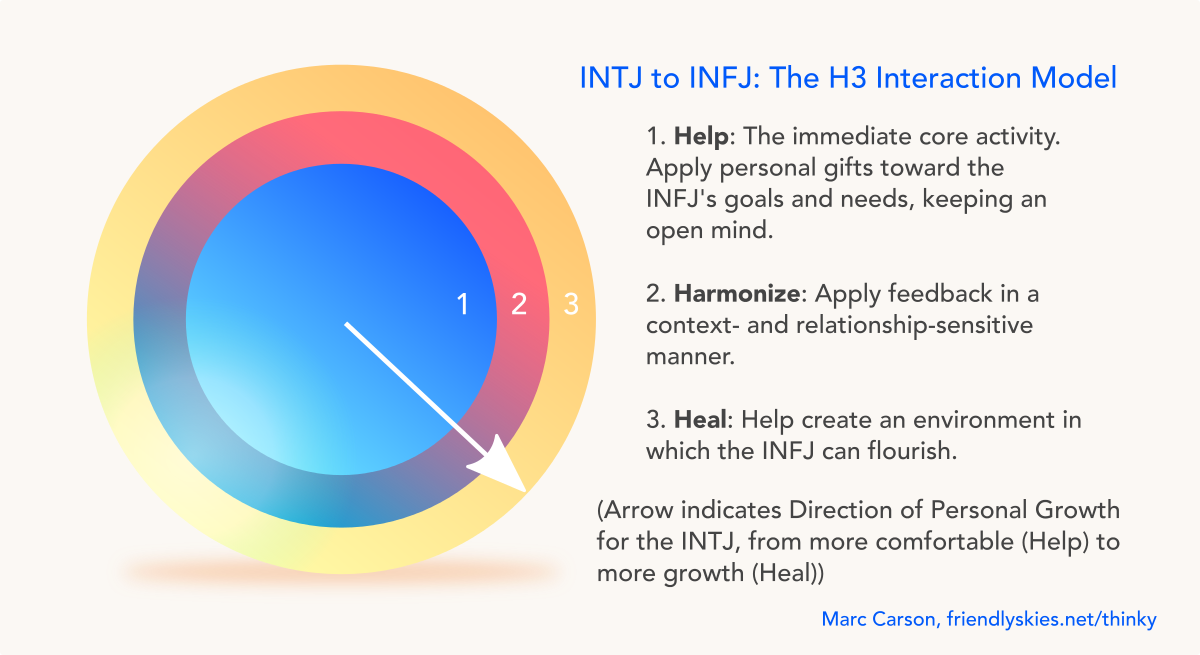
This is my personal INTJ framework for working with INFJs. For convenience, I’ll call it the H3 Interaction Model, and treat it as a whole body with three layers. Those layers are:
Help
Harmonize
Heal
If Harmonize and Heal seem uncomfortable to you, that’s normal for an INTJ; read on and try to keep an open mind.
H3, Part 1: Help
Helping is the core of this creative process. It is crucial to dive in with the intent of helping the INFJ, rather than producing something for yourself, or for your team. The difference in mindset should help an INTJ understand that their task also has a group or social dimension, rather than a simple work product. It is crucial to begin to gain permission from your partner or group, and this can only be done by speaking their language.
Help is useful as a first stage for INTJs, because INTJs are usually excellent at providing the more concrete assistance that an INFJ might need in implementing an idea.
At some point, you can probably help the INFJ by emphasizing that they can be very direct with you.
“Just so you know, I’m kind of dense sometimes and can miss really subtle hints, so please be really direct with me if you don’t feel like I’m hearing you.”
If you beat yourself up a bit, you are giving them permission to be vulnerable. (Don’t worry, the damage to your ego won’t last. :-))
Try to be an order of magnitude less direct with your own language.
INFJs have told me: “Words mean everything to me.”
Be gentler than you think you need to be.
“What I’m kind of hearing [from you] is [thing], is that right?”
Instead of “Just do X,” consider language like, “I don’t mean to try to fix all your problems for you, but have you considered something like X?”
Instead of “Stop doing Y,” try “if there’s any way we could do Y differently, I’d really appreciate that—I don’t mean to be a pain.”
Why do all this? Because they’re probably doing it for you! That’s how INFJs typically operate. If you can give some of that back to them, you’ll gain more of their trust and confidence.
Listen to the INFJas if you are assuming they are correct. Keep your mind mostly open and give your inner critic some time off—for now.
This is not the same as agreeing with everything the INFJ says
If you disagree, simply note and hold onto that thought for now.
If you can’t stand it, don’t do it—but it’s worked well for me.
If at all possible, put their ideas into place first, then give your feedback.
So rather than letting your intuition explain to the INFJ right up front, “that’s not going to work,” go do it, or part of it, or think about it, then come back and relate your experience of it working or not working.
This is hard if your intuition is really dominant in the discussion, but remember it’s healthy to use your secondary objective measurement skills as a problem solving aid. Intuition + measurement = success, very often. Intuition by itself can lead to groundless arguments and alienation.
Try to see things from their POV.
INFJs will often pull original concepts—sometimes surprisingly original concepts, out of a hat.
But: Original concepts can be really fun, even if we do put effectiveness aside for a little bit.
Remember that you’ll be measuring effectiveness anyway, as a good INTJ, so it’s not like you’re giving away your baby here.
They still value your input. They may not speak the language, but they want to hear it!
It’s worth your time to learn to empathize with INFJs and call out their feelings.
INFJs will tend to punish themselves, and nobody wants that. Letting them have their way will often make them more conscious of the fact that you aren’t getting yours. They’ll feel prompted to ask for your input, and will try to find ways to harmonize.
They usually need help with this, as their key cognitive problem solving method is the expression of feelings.
Example: “I got the feeling you weren’t happy with the last one we worked on.”
Example: “You seem so inspired, this is great!” (listen to their response and engage with it)
Try not to talk about yourself very much; they will sometimes latch onto this and attempt to encourage you to do more of it, to their own detriment.
H3, Part 2: Harmonize
The help you give (in Part 1) needs to take place under a layer of relationship harmony, or you risk coming off as fake or even harmful to the creative process. The INTJ will need to begin to communicate their own needs or thoughts, and for maximum effect, this should be done with the goal to harmonize as much as possible while meeting the needs of everyone in the group, including oneself.
If the INTJ’s needs are e.g. “my way or the highway,” this may not work, of course, so it’s good to be aware of the risks of relying heavily on Ni as a convergent problem-solver.
Give all feedback in a sensitive way. Example:
A website design created by the INFJ is not realistic or effective in the ways the company needs, and will alienate huge chunks of its audience and harm SEO because it doesn’t contain any text, just abstract imagery.
“You know, this is a beautiful one-page website. The colors, everything just works. The only thing I’m feeling is a sort of disconnect with our audience—those who really want to read all about us and what we do. Is there anything we can do about that?”
Stay away from “we need to” statements as much as possible.
Remember that a criticism of their work is a sensitive spot (inferior Se) to an INFJ and an INTJ both. Use very light language, explain how you feel rather than saying how it is.
When it’s time to implement their ideas, post-discussion, feel free to add in your own.
INFJs are not huge detail people. As long as their vision has been captured, add-on ideas will often go either unnoticed or uncared about.
In this way there is often plenty of space for a compromise.
This may in fact be the only way you feel it is possible to implement your ideas given the sensitivity of the situation, so you might as well try it out if that’s the case.
Allow for the INFJ to act as irrationally (as it appears to you) as they need to. Remember that their logic function is very subjective, and builds from the ground up rather than building on existing frameworks. While you may not enjoy the way it has to reinvent the wheel all the time, this is how some of the world’s best thinkers have developed extremely solid frameworks throughout history.
H3, Part 3: Heal
Healing is the outer shell that needs to surround this entire process or experience. Regardless of how uncomfortable it may sound to a novice INTJ, a healing environment simply provides ongoing affirmation and appreciation that helps the INFJ understand their important role and feel they have the INTJ’s permission to be their own best self.
Remember that your key leverage points with an INFJ will involve extraverted feeling—putting yourself in their shoes. You may see the relationship as a work project or work experience, but it’s a relationship, first and foremost. Let’s try some of these things:
Example: Noticing their mood and asking how they’re doing. Listen actively and draw out more when you can.
Example: Noticing when the INFJ is getting you to talk about you for a long time, and calling them out on it. Ask and make it your job to turn on their problem-solving, feeling-expressing verbal skills.
Example: Remembering their birthday and saying something about it
Example: Reminding the INFJ at some interval that you have been thinking about them, or the project, or a shared experience.
Did the INFJ take a big step? Thank them. Tell them you were impressed. Help them know that their contributions are noticed.
It would be most useful to drop any perfectionism to which you hold yourself, during this process.
You may find it useful to employ a spreadsheet or calendar reminders throughout this process.
Make sure you are making time in life to use your own gifts.
Is there a creative project you’re working on, away from this project?
What are you learning from the INFJ? What kind of research could be done to expand that?
Tempering Your Approach to Fit Your Comfort Level
Most INTJs will feel more comfortable with Helping than Healing. The model intentionally reflects this, as you can see by the Direction of Personal Growth indicator in the graphic above.
INTJs should feel free to go as far as they’d like in applying the model, keeping in mind the benefits to pushing themselves (personal growth) and risks to pushing themselves too far (irritation, anxiety, etc.).
I believe it would be most helpful to keep a log or a journal for the purpose of reflecting on one’s own comfort or discomfort in using the various stages of the model.
Additional Tips
Probably don’t jump in to tell INFJs what their personality type is, if you ever considered doing that without a proper introduction and monitoring of their feelings about it. INFJs sometimes feel violent opposition to the idea of type, due to their inner need to affirm the uniqueness of each and every person. They may be very attuned to the negatives of what they see as “labeling.”
Use your INTJ objective thinking by measuring the results you are getting. Are these efforts working?
Use subjective thinking to make and refine your own framework. This will make you more efficient should you need to work with this person or type of person again.
These are principles and techniques that I definitely have not mastered yet, but I feel a huge sense of relief now that I am aware of them.
There is a lot of potential for conflict between INFJ and INTJ, but if we work to understand and refine our approach, I believe we INTJs can help make things go much more smoothly.
Most people find telemarketers and spam very annoying, and I think INTJs especially are likely to get very annoyed by the interruption. Some of us seek ways to play with or break the system, rather than just hanging up the phone or deleting the email.
Back when I was in university, I enjoyed joking around with telemarketers. I remember during one call I used a high-pitched voice and acted like a rather slow, immature adult male, asking all kinds of innocent questions about the product being sold. Eventually the caller couldn’t stop laughing and her supervisor came on the line. Then they put me on speakerphone and hung up after another minute or so of laughter.
A few years after I started my business, I started getting Skype spam for business products. I engaged one of the spammers and found out they were from another country. In that case I pretended that they had contacted me separately about another matter entirely, and using their own terms as a sort of code language, proceeded to send them attachments from U.S. defense industry companies, like PDF ads for weaponry, small helicopters, etc. I expressed that I was happy to help them with their “interior problems.”
Of course, I immediately regretted that one. The spam stopped almost instantly (for the time being) after I received a forthright reply in protest, but I do think my response was overkill. I shudder to think that my response to a telemarketer could have resulted in some (semi-)innocent person being marked as a potential troublemaker by their government, or worse.
Just recently I received an unsolicited “private number” call from a company and told the caller, “hey, what is your company name? You called a cell phone, this is not cool, do you realize that?” The caller spelled out the company name for me, then said, “well, we are an offshore company…” as if that made it OK to engage me in a way I didn’t want to be engaged. I then asked to be removed from their phone list. The caller just ignored that and continued with his sales talk. So then I replied, “OK, so your company name is [name], right? I am going to write a blog post about your company and this phone call, sound good to you?” This seemed to shock the caller, who said, “ah…..no” and hung up. His voice cracked a bit and he sounded like he wanted to be done with the call.
That last one went pretty well. Probably better than sending weapons documents. You would not believe how kitted out some of those PDFs are, by the way.
This was interesting to me on a global politics level.
How does the Chinese government see this announcement?
We’ve got to get in this game.
Gather as much information as possible.
Encourage international involvement so that the machinations come closer to your own shores (e.g. Japan) for easier infiltration, influencing, etc.
Develop strategy for response to this. For example, the issue of ecological damage might be a great leverage point with which to influence international opinion.
We’ve got to prepare for any outcomes that can harm us
Technology development will be huge here. We will be out-developed.
How do other governments see this announcement?
A broad guess: Money.
Either losing it (to being out-competed in space technology—Russia)
Or gaining it (related services, expertise, etc.)
Mutually-assured destruction: Is it assured anymore, when you’ve got people living off-planet?
If it’s not assured, don’t we have a problem on our hands?
Example: The colony could be an off-world military asset.
How hard would it be for an adversary to wipe out a Mars colony? What would be necessary at the various stages of colony growth? And in return, how could the colony be hardened or made resistant to attack or infiltration?
Cognitively speaking this was also very interesting.
It’s like a Ni+Te dream story.
Musk is a great model for INTJs.
Dream it up with Ni (introverted intuition). Dream as big as you can!
Use Te (extraverted thinking) to measure the requirements and run the numbers.
Result: Probably something pretty great, even if it doesn’t match your original vision exactly.
Most INTJs will probably never reach half of their potential, if you express potential even as “one Musk unit” or something like that.
As an INTJ, I need to dream bigger.
And I also need to back that up with measurement, spreadsheets, assessments, new frameworks as needed, etc.
I don’t need to be Musk himself to be happy, but I’d be bummed if I didn’t reach for my maximum potential
Leveraging my own gifts of course, not necessarily Musk’s.
There are INTJs who feel totally in control of their lives.
There are INTJs who feel like victims every day.
There are INTJs who love dry humor and joke grenades.
There are INTJs who absolutely do not get jokes.
Some INTJs can’t accept these differences. They think, “oh, she didn’t get the joke. She must be an ISTJ instead of an INTJ.” (Holy cow.)
Instead of “that’s new to me,” we zoom right back to the typical “oh, I already know everything about INTJs and therefore, that must not be one.”
On the other side of this, perhaps people have accused you of not being INTJ enough to be an INTJ. Dario Nardi says people have told him he’s actually NF, or probably SP.
“Nobody ever complained that Einstein wasn’t a great painter.” —My INTJ dad
Part of the INTJ journey is discovery. Discovery of your gifts, discovery of your weaknesses. If your weaknesses piss you off, that’s normal. Especially for an INTJ—we sometimes think it’d be best for us just to become good at everything.
(Which: Isn’t that like the dumbest idea ever? Seriously.)
If you want to develop your gifts, that’s normal.
If you want to develop your weaknesses, that’s normal, too.
But I will bet on the former any time. Wish I could say that about the latter.
Understanding my gifts has been the most rewarding part about Jungian psych and MBTI for me. I found gifts I didn’t even know I had, and I hope you find the same. Weaknesses can always wait.
The traditional INTJ “blind spot” cognitive function is known as “extraverted feeling,” or Fe for short. Have any of the following ever made you uncomfortable? Maybe you rolled your eyes at them, or joked about them?
Terms of romantic endearment and other similarly “feely” or “gushy” language
Respect for, and deference to, social authority and position “Esteemed Sir, we humbly thank you for deeming it worth your time to…”
Phrases like “Warm regards” at the end of an email (personally I get as far as “best regards” and then I’m shot)
Polite, happy small talk that feels like it can go on forever
Creating or discussing “safe spaces” where people can “express or feel what they need to feel”
Deciding what to eat at a restaurant, based on how it will make your dining partner feel?
Deciding how to introduce yourself, and downplaying yourself, communicating more emotively, or acting out of authority, based on the social hierarchy-level or even job title of the person you are greeting?
Writing a letter of recommendation for someone you feel like you barely know on the surface?
Maybe you’ve heard: INTJs are “thinkers, not feelers.” But this hides the important truth that we are feelers, just different feelers than the extraverted kind.
How INTJs typically “feel”
In the most common Jungian function stack model of personality, INTJs use “introverted feeling” (or Fi) as their tertiary psychological function. As a result, INTJs may:
Feel attached to strong inner values, needing to “find the me” in whatever they do
Attach warmly to animals
Attach warmly to people who seem like “lost causes” or outcasts, wishing to affirm their essential acceptance of their humanity
Feel devoted or loyal, especially to someone they feel is loyal to them
Place a high price on their loyalty: For example, one failure to keep their trust merits a complete breakdown of all trust
Behave in emotionally manipulative ways under high stress (for instance, telling very sad stories about one’s past in order to obtain sympathy)
In extreme cases, be accused of selfishness and self-centeredness, especially by those who prefer the more socially-oriented extraverted feeling.
Hesitate to recommend someone unless they feel like they really know and trust that person’s character in depth
Some of this probably sounds ridiculous too, but Fi is a necessary part of the human experience. When we use Fi in a black and white manner it can cause problems, but in normal, day-to-day use it also may bring creative opportunities and help us feel like our life is worthwhile.
I like to recommend using Ti (introverted thinking) to develop frameworks or sets of rules for allowing our feelings to guide our decisions.
For more on Fi and Ti, I recommend Dario Nardi’s book, 8 Keys to Self-leadership.
Anyway, back to extraverted feeling…
“Fe,” or extraverted feeling, is the counterpart to introverted feeling. Where Fi is big on one’s own subjective values, Fe works with a broader set of widely-understood cultural values and standards.
If Fe was a person, he or she might be, for example, a fan of the governor, the mayor, the CEO. Fe is big on the importance of one’s official role. Fe loves certifications, qualifications, and advanced degrees.
Fi, on the other hand, might thumb up its nose at all that, and rather hang out with a more authentic person, even if they live in a gutter.
Fe shudders at gutter people, unless the entire social group is shuddering. Then Fe will tend to shudder right along with them for the time being.
Fe is sometimes found combined with Ti in a personality type, with the result being a person who is capable of swindling people with a honeyed tongue, or a savvy political maneuverer. A very social, very crafty plotter. In positive cases, perhaps a Fe/Ti user will use their convincing charisma and social grace to find clever ways to benefit humanity, or create opportunities for the disadvantaged.
Fe is fantastic at energizing group relations, and maintaining a balanced sense of positive energy, so that great things can be accomplished.
Still, regardless of the upsides, Fe can seem really uncomfortable and worthless to the INTJ.
And that’s really too bad: Even if you’re an INTJ, you still need to build rapport and interact with others. We all do. Fe is actually important, it keeps society and group cultures moving along generally peacefully and we can appreciate that in rational terms because it’s already in place and it’s working, helping our civilization forge ahead.
A funny example of Fe-style communication
When I was a kid, when everyone was exchanging cassette tapes with their girlfriend or boyfriend, two of these tapes ended up in my possession. One, I either stole from my sister or she left it behind when she got married and moved out. Now, as she is a Fe-aux, and had a tertiary-Fe boyfriend, it was hilarious. The tape was made by this boyfriend, who uses Fe about as awkwardly as we INTJs use Fi.
I pressed Play and heard this:
“Hi Carmeleeeeee [I’m pretending my sister’s name is Carmel here because I think it’s funny]…I hope you are having a…just a…wonderful day. It’s so sunny here where I am, the birds are tweeting outside…all I can think of is you. I hope you enjoy these songs, sweetheart. Love you so, so much!”
I can’t communicate the various vocal tones here, but just imagine a grown man trying to sound like a young woman and you’ll get the idea just fine.
Another tape, I later received from an ENFJ girlfriend, Fe-dominant. In that case, it wasn’t that the tape had corny language on it (which it did), but more the fact that it was a thing that was done back then, a relationship formality. That’s a huge deal to a Fe-user. And really I just put it into my cassette player, listened for the first few minutes, and turned it off. It was just so awkward.
The thing about Fe-dominant personality types (ESFJ, ENFJ) is that sometimes the “empathetic and respectful” language gets so well used that you feel like you’re talking to a corporate mission statement. In environments like these, where Fe is overused, you can usually find INTJs and INTPs who are so burned out by corporate life that they read Scott Adams, get incredibly pessimistic, and then eventually quit to become Buddhist monks, or maybe writers of satire.
In my opinion, it’s better to work to understand Fe (the Dario Nardi book mentioned above is a good start) and maybe integrate it into your life a bit, and still have the casual laugh about it, than to completely mock it and then end up completely unprepared when you end up managing Fe-doms or needing to work under them. That set of circumstances would almost be the definition of “suck” for an INTJ.
The Fe Blind Spot
There’s also an effect called the Fe Blind Spot, in which an INTJ or ISTJ will find themselves so wrapped up in their own Thinker-Planner perspectives that they say or do something completely inconsiderate and inappropriate with regard to others. For example, someone tells you their dog just died, and you reply by asking them if they’re ever going to finish that spreadsheet you need! This can feel incredibly embarrassing, especially when others point it out, or use it as leverage to take you down a notch.
So that’s Fe. I hope it made you cringe and roll your eyes a little bit. You introverted feeler, you.