
Speaking of UFOs: Why the Sudden Stir? One Theory
Friday April 26, 2019*
OK, here’s a theory regarding the sudden UFO-related “let’s look into this more than we were” stance.
This is in response to an article I just read, titled What The Hell Is Going On With UFOs And The Department Of Defense?
Remember how I talked about the way the military’s organizational personality might make it an unwitting sponsor of UFO cover-ups?
Now let’s take the reverse. What kind of personality type would you bet would want to know? Like really want to know exactly what a thing is?
First, extraverts would be my bet. And I mean—as a group, right? Because type is a group thing. And Jung’s position on extraversion was that it essentially indicated a type of person who was energized by “outside objects”.
Anyway, zooming in a bit further, I’d have to give the “would want to know” award to the Se-dominant ESTP.
Which: We have an ESTP Commander-in-Chief right now, here in the USA.
So imagine with me, a conversation…
- Navy Admiral: “Mr. President, it’s nice to meet you sir.”
- CIC President Trump: “It’s very nice to meet you Admiral, thank you for your service, you guys are—we have an amazing Navy today…” (Blah blah blah ESTP Fe-Se stuff)
- But Still President Trump: “Hey listen, what do you make of these UFOs. You’ve seen the videos—that was a Navy incident right? Back in 2004 or something.”
- Navy Admiral: “I…I don’t know, sir. It’s a mystery for sure.”
- President Trump Going Full Sensor: “But don’t you want to know? I mean, I’d want to know. These things, they fly faster than our jets, and they can really maneuver!”
And that, right there—I’d say a conversation like that could 150% cause the aforementioned “what the hell is going on” stir within the Department of Defense. The guy is the CIC, we’re the Navy, he wants to know something, and we HAVE THE INFO. Well, we have some info at least. And we did make the darn video.
So: 1 + 1 = 2, intuitively speaking in this case of course.
Another factor to consider is the emergence of To the Stars Academy of Arts & Science, which has attempted to exert pressure on the US Congress. To what degree this has been successful, I have no idea. The team and its communications strike me as near-bizarre, but I haven’t made a very deep dive. [Does DeLonge feel to anyone else like a rocker ESFP who has taken a sudden hard turn toward the INTJ sphere of interest? Reminds me of a few people I know…and you never know what kind of e.g. publicity or other help they can lend to us intuitives. Also, when the guy sets up three corporate divisions and those divisions are Science, Aerospace, and Entertainment, I mean it’s getting hard to reach another conclusion here, right?]
The The Drive article linked above is great though, and links to some interesting Youtube videos which I haven’t finished watching yet.
And Jason Turner, in that last video, talks about the existence of a SES, or Signal Exploitation Space, within the USS Princeton. How freaking cool is that name? Apparently it’s existed for some time now but it’s the first time I’m hearing of it. And I mean, you know how I hesitate to really boost your ego, but given the way Ni works you could safely say that the INTJ brain is a Signal Exploitation Space. Right?
This weekend just went into the UFO zone. Man I swear at least 75% of my weekends do this.
Filed in: Se /25/ | Technology /41/ | Sensation /40/ | Openness /49/
An Example of a Fi Solution to INTJ Procrastination
Friday April 26, 2019*
If you get Thinking over-involved in solving your procrastination issues, you’re gonna wear yourself out at some point.
Some thinking will help. My Productivity Triangle model can help in that way.
To over-involve thinking looks like: Jumping from one productivity tool to the next, trying to find the holy grail, then getting to the point where you feel like a failure, yet still hold out hope for a solution, a way to leave no project unfinished!
But a lot of INTJs, ISTJs, ESTJs, ENTJs, and on and on…need to get away from thinking for a bit and learn how to develop, and maybe more importantly normalize their system of boundaries. Make its expression sound less selfish, or learn to express it with more nuance.
Here’s one way that can look:
Mental Model
“It’s just part of who I am. I procrastinate some things.” See, Fi is, at least partially, about developing a model for what makes you, you. And what makes you acceptable and even valuable in the face of your weaknesses.
Remember the article about Se and how badass we’d love to look? This can get in the way of a perfectly fine solution to procrastination, one where we give ourselves the freedom to laugh at ourselves and admit that we procrastinate.
And…
Additional Considerations
Here’s how that can look. Imagine that your romantic partner just asked you to build them a gazebo, and the last one took you almost 6 years to complete (which culminated in an amazingly busy weekend in which 80% of the work was done).
- You know what kinds of projects you procrastinate (you’ve analyzed these right? Example: Stuff other people requested; stuff that’s really sensory, etc.)
- You know how you feel when you procrastinate (the distance between real and imagined self has never seemed so great)
- Therefore, because this project seems like the kind of thing you would procrastinate…
- “I’m sorry, I really wish I could take it on and do an awesome job for you, but I think you should ask X to do it instead.”
Nailing the Communication of that can be Hard
It’s easy to piss somebody off if your Fi hasn’t been sprinkled with a little Fe. So give that some consideration. Nobody likes to hear “I could help you, but I won’t.”
If you have decided to set a boundary and you are not going to take on the project, consider your relationship to the person making the request. If they’re relatively close to you, see if you can provide a little help in some other way. Say you’re sorry about it. Give some suggestions on who to ask. Or, offer to get the project started and then mentor them on it, as a way of teaching a new skill.
Another layer of Fi which can help out
Another part of this is doing more things you personally value in your life. This can help you understand that you can make a difference, and that what you want can be enough for yourself, even if it doesn’t seem enough for others.
Maybe this means changing your job, or maybe it means understanding your job even better, or maybe it means concluding that life outside the job is so fun that I don’t even care about my job not being a perfect expression of my gifts anymore. I can live with it now, and by doing so I just saved myself a huge amount of trouble.
You never know where Fi will take you, but it should generally help you feel more energetic about, and appreciative of, life.
Summary
People procrastinate different things for different reasons. INTJs are possibly least likely type to procrastinate things that are important to them. By definition, they tend to find themselves automatically doing those things. But that can leave others in a lot of pain, if the communication is mishandled.
By the way: All types struggle with procrastination. The dynamics are different, and not everybody needs to learn about Fi for extra help. Some need to learn a little bit of Te in order to not get fired because they literally cannot take seriously the boss’s request to make a checklist, for example. As weird as that is to hear for INTJs…
Filed in: Control /112/ | Fi /35/ | Thinking /70/ | Feeling /64/ | Productivity /120/ | Te /36/ | Procrastination /23/
In Which We Get an RSS Feed
Friday April 26, 2019*
Just to integrate into your systems a bit better, we now have an RSS feed. It’s in the sidebar. Thanks to C. for the nudge & kind blog feedback.
RSS Reader Applications
C. tells me he uses the Tiny Tiny RSS reader, which looks good, and seems relatively easy to set up on a LAMP server. Personally, I’m in this “back to traditional desktop apps” phase myself, so I’m using Liferea which also seems to “synchronize with” C’s Tiny Tiny RSS app.
I periodically export an OPML file (like a list of my RSS sources—blogs and things) to Dropbox so that it’s available on my phone or other devices if I want to try out a reader app there.
How do you even say that?
After using it for years, I still don’t know how to pronounce “Liferea” in any way that doesn’t sound like a symptom of a tropical disease. The FAQ contains this gem of an explanation, which left me with an even worse possible pronunciation:
“‘Liferea’ is the abbreviation for Linux Feed Reader. It doesn’t really matter how you pronounce it. I sounds pretty strange when trying to pronounce it like an English word so I’d suggest to pronounce it like a Latin word.”
Now here we have a psychology which resists the canonical. “It don’t matter, baby.” I personally can’t but cringe when I try the Latin version. “I’m using Leaf-eh-ray-uh, which is um…”
“Sounds like a Linux app with a website from 2006 or something?”
“Yeah.”
I’d prefer to pronounce it like “Life-ray,” which intuitively feels pretty cool as it personally gives me those happy Japanese mass-murder cult vibes in a cutesy sort of way.
But I’m guessing it’ll never come up in spoken conversation. And I mean, the app itself works fine.
Filed in: Technology /41/
Reader Requests
Thursday April 25, 2019*
I always appreciate reader feedback on the blog. Here are some ideas I’ve received from a reader recently, for topics to address:
Paralysis in the face of an overwhelming workload
Throwing out a few of my favorite techniques here:
- Begin to craft your anti-paralysis science. You’ll need at least a log and a calendar to start with.
- Take opportunities to get out of your normal environment. While in the new environment, bring your ideas around to the paralysis and make a simple action plan.
- If you’re not talking, or writing, or singing, or otherwise getting it out of your head, the paralysis has a greater chance of winning.
- Yes, it matters to you to get better at this stuff. There’s always some existential excuse for why it doesn’t matter in the big picture. But once you feel yourself getting a little better at it, your overall sense of well-being will improve.
- In the future, consider changing your boundaries to reduce the likelihood of this happening again, if possible.
Getting trapped in what I think is good work vs. what employer values/measures/rewards
I probably need more specifics on this one, but if you can list exactly what your employer values, that gives you tremendous value to the organization. Even just saying it out loud in meetings can help the organization feel a sense of calm and provide you with protection. Compliment your coworkers and leadership on those values. Don’t generally accept compliments in the area of those values, just explain that you have a long way to go. Especially in SJ organizations.
Meanwhile, do your best work on your personal projects. Never let up there. You need to maintain a sense of pride in your work.
And: Start working to forge a career that ties more deeply into your value system. Everybody needs that.
Wanting to brag vs. wanting to share cool things
So much of this is subject vs. object psychology. If the object, the person with whom you’re sharing cool things, is a good person to share these cool things with, it’ll go well. If not, it won’t. So watch for that. What do they think is cool?
It’s nice to have someone to brag to, but we INTJs also kind have an unreasonable fear of weakness. See if you can work your way through that.
And when it’s time to brag next: Have an intuitive conversation with an ESFP in your journal. If you haven’t done that, pick a well-known ESFP, or let one appear to you and talk to them.
I remember once on a long drive through the SF Bay area during the sunset hours, I had a back-and-forth imagined conversation with Larry Ellison. The guy came out of nowhere. He’s a known ESFP, but I didn’t know that; I knew next to nothing about him. I guess my subconscious picked up on him somehow, and we had a long talk.
Larry let me brag. A lot. I wouldn’t brag to anybody else like that, but I’m telling you, that conversation (not so much the bragging, though it was definitely there) changed my life. The comfort I received from that simple mental exercise with my subconscious mind has paid huge dividends ever since and marked a pivot point in my adult life.
So yeah—brag when it’s appropriate, brag when you feel comfortable doing so. And, watch out for those opportunities. Reflect on what you’ve done! Every INTJ I meet has done a LOT of cool sh*t, no matter how they see themselves.
Getting emotionally wrecked when someone accuses me of cheating them
This definitely feeds into our need to be perceived as a certain type of person.
Keep in mind that people who make accusations will often do so not because they really feel their argument is a good one, but because they’re being prospective. They are being analytical, feeling you out, trying to see what will make you take the wrong side of a very small-picture negotiation.
There’s a science to this—log it, keep track of it, watch it, and you’ll get it.
Also keep your ear to the self-care world. This world really cherishes and protects Fi topics like vulnerability, personal worth, etc. It can help an INTJ out in this area.
Filed in: Relationships /78/ | Productivity /120/ | Therapeutic Practice /147/ | Coaching /27/
Wading Into Ufology: Some Observations from the Personality Zone
Thursday April 25, 2019*
(This post was updated in October, 2022)
One zone or topic of study that I really enjoy, as an intuitively-driven person, is the fringe territory of human concern. Examples within this area include UFOs and Ufology.
Personally it’s unthinkable to imagine growing up as an imaginative, conceptually-fascinated kid without developing a talent for finding every library’s UFO book section, and feeling that natural, inner-intuitive connection to the question “what kind of mysterious stuff is out there?” Metaphorically this has always risen up through my consciousness as an attractive, naturally-chaotic spectre.
And I think chaotic is an important word to consider. To explore Ufology is to open yourself up to chaos, in that you immediately begin to upset traditional mental paradigms. Especially if there’s pressure to name stuff or decide what stuff is or what it means.
“Sometimes,” my coach told me, “you have to stir up a little chaos, see what happens.” And we’re good at that. Us intuitives stand out in our level of comfort with ideas. We make good planners. And in a lot of cases, we like the idea of stirring up the current thought process or accepted body of theory with something new, sensational, and mostly unknown. Does it make others feel uncomfortable? Yes, especially if they love the already-known, like that guy who has eaten a Big Mac every day for decades. But, sorry, life is like that; humanity is like that. Get used to it. It’s part of growth to look into the unknown and maybe even learn to stare it down.
Getting into four-letter Jungian type, for example, us INTJs even take that further and happily predict that chaos is simply part of our future, and furthermore we tend to say, “it’s OK, we can plan for it and harness it,” and this can really freak other people out.
Because how can you really know that? How can you even know you can do something about this unknown chaos?
Moving one letter away in personality type, and yet still managing to shift over to a different psychological world in many ways, our friends the ISTJs are a great example of a type that does not particularly enjoy chaos and future-intuition or prospective intuition. Individuals differ, but as a group, definitely.
You know who’s a great fictional ISTJ? Agent Scully. She’s a fantastic counterpart to Agent Mulder’s shattered-ideals intuitive type, the ENFP pursuit-of-truth persona.
In The X-Files, Agent Scully is Mulder’s interface to the government. She’s assigned to him, and she reports about him.
This makes sense, because the government and especially the military, judiciary, and law-enforcement aspects of government are famously compatible with ISTJ psychology.
You can even say that most of these groups generally have an ISTJ psychology, no matter which individuals of whatever personality types work within them. (This is called Aggregate Type, or Integral Type, by various authors.)
So, circling back to the non-fiction world: You know who I think might be a great real-life military ISTJ, who’s also one degree away from Ufology?
In the BBC World Service podcast, Witness History episode titled UFO Sightings: The Rendlesham Forest Incident (story starts about 35 seconds in), you can hear the account of one Lt. Colonel Charles Halt, USAF.
Colonel Halt went to investigate a possible UFO. He brought along a geiger counter and a tape recorder. He took measurements and made recordings. Nice work!
As I’m listening to this, I’m excited. He took these measurements—great! That’s helpful. “It must be under some type of intelligent control…” very interesting idea…
And what’s the Colonel’s take on the whole thing? I mean, as a first-person observer?
Guys, let me just say that his take on this is so ISTJ.
A direct quote:
“There’s no doubt it was something beyond anything we know or understand. […] I have concerns, but I don’t think we can do anything about it. I think this is beyond us.”
“So: Quit worrying about it.”
Sorry Colonel, WHAT did you just say? Did you just talk about increased radiation levels, a craft of unknown origin, a floating red eyeball-like object?
And then did you tell us to quit worrying about it?”
A theory, but maybe not a crackpot one: The Fear of Chaos Model
First: Let me just be clear that I’m not worried one bit, Colonel. Why worry in the face of such potentially valuable information?!
Second: This is where I’ll announce my UFO cover-up theory.
I don’t think there’s a grand conspiracy to cover up UFOs. I think it’s far, far more likely that world militaries and governments cover up UFO-related information out of this exact psychology, this “there’s nothing we can do, it’s beyond us” idea.
“Sure, it’s something radical, but it seems so beyond us, and really guys—what can be done?” Shrug.
The coverup happens because there’s no value proposition to the subjects involved. There’s no intuitive “prospecting” at work on their end, just a whole lot of introversion (in the “new and strange stuff drains your energy levels” sense of Jungian introversion) and fear of chaos.
See? That’s also a coverup. Especially where INTJs, and NT types in general are concerned. Because we can do something with that information. But at the same time, we can’t guarantee that it won’t upset the SJ / Stabilizer organization and cause any kind of chaos.
Well: For these and other reasons, we INTJs and NTs in general don’t typically run the military or match well its organizational psychology. So as a result there’s this natural, psychological information dam regarding the prospective / intuitive field of UFO research, and I think that’s the coverup, if there is one.
It’s simple to explain, it’s based in organizational and individual psychology, and I believe far more effective a thought-model than the “behind-the-scenes conspiracy” stuff.
To clarify regarding ISTJs
“Marc, so you’re saying that ISTJs are behind a world UFO coverup?” Sweet Jesus No. I’m saying that a specific psychology can cause a coverup of certain information, no matter the type of the individuals who are covering things up, or just preventing exploration-motivation from spreading within an organization.
I have lots of ISTJ friends, and I’d hate for them to be painted with a “wow you guys lack imagination” brush or worse. The fact is, they’re all different. Really what I’m aiming at here is group and organization psychology. I’ve witnessed it first hand; I’ve been a part of it. Keep your head down, stay on track, don’t deviate, and deliver what everyone expects you to deliver—stability. Some things we just leave untouched.
INTJs and INTJ groups of course build their own “information dams” too (though not generally with topics like science fact/fiction).
Phew. That was pretty fun to write. I have other theories on this stuff but I’ll bet you guys would hate to hear them. Really out-there stuff…
By the way, the US Navy just announced new rules for reporting UFOs. Let’s see how things unfold from here.
Filed in: Interests /112/ | Intuition /63/ | Si /19/ | Openness /49/ | ISTJ /2/ | Ne /17/ | Ni /42/
Some More Updates: Wargaming Session, Religious Group Psychology
Wednesday April 24, 2019*
I’ve been playing tactical skirmish wargames lately, likely a reflection of the tactical skirmishes in which I find myself at work. ;-) Some days it’s like playing calendar warfare…
Anyway, I wanted to mention that One-Hour Skirmish Wargames is a really fun wargaming system reference book, and the system is easy to learn. I played through a game last night and I’m excited to do so again, and again, using different settings and scenarios. You can read the author’s blog post about his book and purchase it through popular online book stores. I’ve no relation to the author, just a happy customer.
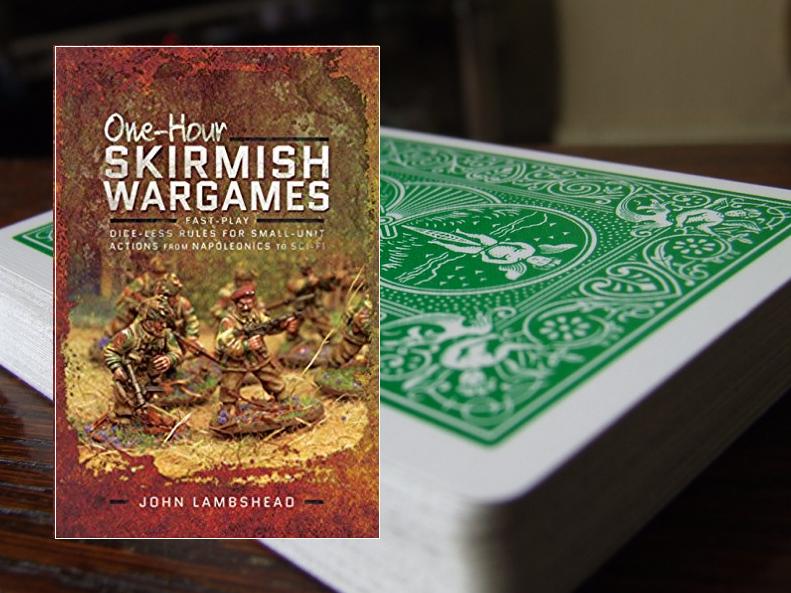
One unique aspect of this game is that it uses playing cards for calculation rather than dice. At first I thought this would be a pain, but it’s actually very intuitive (easy to figure out; easy to remember) and logical. It’s easy to see how you could abstract these rules into a general simulation, even non-combat.
I was feeling lazy, so instead of playing with miniatures I set up my own playing area and “figures” (colored squares) using LibreOffice Draw.
Yep, playing against myself. Under some circumstances I would hesitate to include that little bit out of embarrassment, but doing so here might encourage my INTJ audience to pretend to be something they’re not. Winky-winky
Here’s a screenshot:
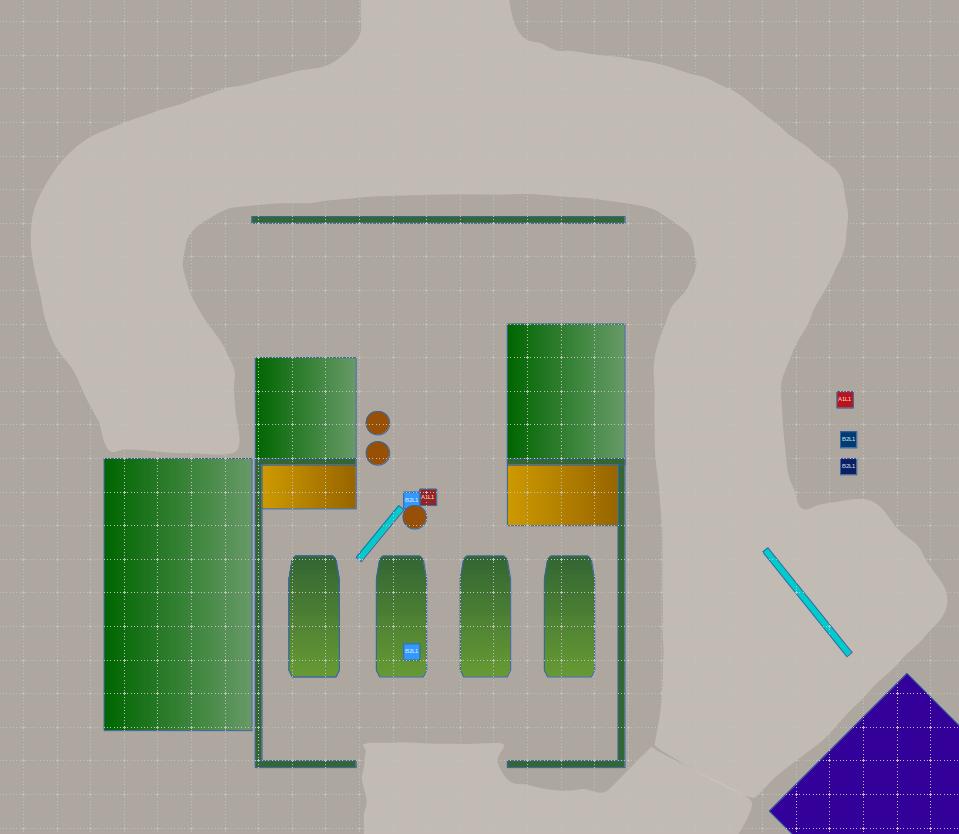
In this screenshot you can see that the Blue Team player at upper left just charged into close-quarters combat with the final Red Team player and finished him off. Which was pretty exciting during gameplay and the game managed to give it a low-technical-overhead, cinematic feel. And of course the poor guy was defending against this random surprise attack on his vehicle depot anyway, so there was a certain tension in the air that emotionally biased me toward the defenders.
The Blue Team won, though the Reds were outnumbered 2:1 and had no additional advantage via skills management. You can see the dead characters on the right side of the image. Sadly, the Blue guy sitting on top of the vehicle just lost his buddy, though he did use the body for cover! The light blue bars you can see on the map are movement rulers.
The game adds some randomization to turn configuration, so it’s possible for one player to get more turns than the other via luck of the draw. Also, if a player draws a joker card at any time, their turn is instantly over! This is a fascinating element and added a bit more “who knows how it will turn out” character to the game.
I enjoyed discovering that not only does the game cover historic settings like Napoleonic battle, it also goes right up into future settings with all kinds of cool gadgets. In addition, there’s a skill system by which you can design an elite “dead shot” sniper or a naturally athletic soldier who runs faster than others, among the various possibilities. Crew-served weapons and tanks are also designed right in. In retrospect, it’s easy to see how a couple of my Blue Team players could have at least fired up the crew-served HMG on top of the vehicle, and possibly even run over one or both of the Red Team infiltrators, from an unassailable defensive position.
I could have also given the Red team rockets and had them yell WOLVERINES or something.
…and heck, I could have thrown in Doctor Who and the TARDIS for some interdimensional fun.
Well.
Next time. Dammit.
Anyway, if you like this kind of thing, definitely take a look. My simple play-through was intense and enjoyable. Next I’m thinking of going straight from a modern setting into fictional-feudal Japan. A powerful castle concealing a dying warlord, attacked by a desperate invader with a deadly secret of their own…
Other Stuff
I’ve also made a deep dive into investing and have already shared some of my learning outcomes with clients; they’ll probably have preferential access to this information for now as I work out additional client benefits to send their way. (Suffice it to say, active coaching clients are getting lots of good stuff. If you want to be a coaching client, or just want to try it out, fill out the form at www.marccarsoncoaching.com and we’ll get you set up.)
For kicks and giggles, as I was studying others’ investing models, I started developing a psychological investing model of my own in parallel. It lacks some parts for its heat-seeking warhead, so to speak, but I believe the payload is solid. We’ll see how that sensor suite turns out.
If you’re like me and you hate being excluded from things due to publisher fiat, and always want the full informational deal, pitch me on any ideas you have for publishing this stuff without necessitating you being a coaching client. I’ll listen.
I’ve also been researching the Japanese Aum Shinrikyo cult / religious group as it has been really interesting for me. One of my favorite books on the topic is Religious Violence in Contemporary Japan, by Ian Reader.
You can see one of my favorite interviews with Aum cult leader Shoko Asahara here. I believe he was an INFJ, and you can see a fascinating aspect of this in his positive engagement with the male co-host, Takeshi (ESTP). These opposite-type attractions are always interesting to watch. In this particular case the culmination is probably around 11 minutes in where INFJ Asahara pays the highest compliment possible in telling Takeshi that he could even be a cult leader himself! Rewind a bit to learn more about the high esteem in which a cult leader places the ability to communicate with charisma.
Speaking of charisma and ESTPs, take a look at Sri Gary Olsen (YouTube clip) for an example of a religion / group started by an ESTP (MasterPath). And I feel I should mention—I can’t give any kind of recommendation here, just sharing info!
Heading closer to our cognitive home as INTJs, the Mormon church is currently headed up by a member of our opposite type: The ESFP, Russell Nelson. You can hear him discuss his strong, and more effeminate, Feeler-type aspirations right at this point in a recent address. Another example of a charismatic leader. “Take your vitamin pills” was his first uttered hint of an agenda which has been rather chaotic and full of changes to the traditionally ISTJ-natured modern Mormon church. I say “modern” because the long-deceased founder of the religion itself was another charismatic ESFP, Joseph Smith. Backing up his charisma was a remarkably hyperbolic interpretation of what was called “second sight,” “spiritual eyes,”—in Jungian terms, the opposite of ESFP Se: Introverted Intuition, or Ni, the dominant function of the INTJ. We INTJs know Ni very well (and probably have a firmer, less hyperbolic grasp on it), but that charisma…
Well, bummer as it is, charisma is not generally a big selling point of the INTJ type, though individual INTJs can often develop it to some degree. Instead we mostly fantasize that we have the ability to pull apart cults of personality like they are the most basic of knots. ;-)
I do have a friend who lights up my INTJ-meter and who is a pastor, and you can listen to one of his sermons if you’re interested. Again, I’m not affiliated and can’t recommend it for anything but curiosity reasons here, though Pastor Chris is a good guy. The charismatic vocal characteristics are present, though somewhat less notable than is the appearance of extraverted sensing (Se) values through the use of a small physical object lesson, a Lego.
“Of course an INTJ pastor would bring a Lego to teach a lesson.” Right? Curiously he also uses the “what’s wrong with this picture” approach, which I use all the time in lessons in front of people. The thing that surprises them, tricks them (ESFP); throws them off. We do like that stuff.
Just a bit more on analyzing religious groups
If you’re new to the experience of examining and analyzing religious groups, let me share one important secret with you: The religious person is attempting to communicate a given set of psychological values. Using this viewpoint, you can make the process of analysis somewhat less personal and avoid getting your feelings tangled into it.
In Jungian psychology, psychological values can be broadly divided into two groups: Perception and Judgment. How does the group see things—what kind of information do they pay attention to, and what do they think should be done about it? In what way do they think others see or perceive incorrectly, and in what way do they think others act or judge incorrectly? These are really powerful lines of inquiry.
Filed in: Therapeutic Practice /147/ | Interests /112/ | Rest /22/ | Energy /121/ | Books /10/
Communicating with INTPs, What to Know Beyond the Basics: Critical Parent Loops
Wednesday April 24, 2019*
Looking back at my university years, there was no one quite like an INTP professor to get me participating in a class. And on top of that, I automatically seemed to become the challenging voice in those classes. The “critical parent” model of communications, which compares the subject’s 6th (non-Socionics) cognitive function to the subject’s dominant function, does a great job of showing why.
As the theory goes, if you receive feedback which speaks to the role of your 6th cognitive function (this is Ti for INTJs), you instinctively feel like you are being criticized or ignored (thus the “critical parent” voice), and a pressure arises within you to push back, to react sharply.
Within a two-way, mirrored-functions communication like the INTP (Ti & Ni) and INTJ (Ni & Ti), what’s going on is that the person you’re talking to metabolizes information in a different order than do you. Their subconscious mind is attempting to block the information you’d prefer to metabolize, and it demands more readily-metabolized information instead. This often feels frustrating for both parties.
As a student, I felt my INTP professors’ viewpoints were overly details-focused, nose in the weeds, and practically blinded to the big picture.
For INTJs, the INTP’s dominant Ti message, “be precise and logical, show your work, make sure to communicate WHY the pieces fit together” often sounds like, “you should get mired in all the details rather than relying on what you know will be the outcome!”
For INTPs, the INTJ’s dominant Ni message, “use your intuition, think of the big picture, see the outcome” in the critical parent mode often sounds like “you should make assumptions rather than using all that precise logic! Anyone can see how this will turn out! What are you thinking?”
Note that I said that’s what those voices sound like. Ni and Ti are both extremely beneficial in their own ways.
As a personal observation, the INTP will sometimes refer to “history shows that…” or “if you do this you will know the system in detail and thus improve your memory” outcomes (Si – recall) to justify the use of more Ti.
The INTJ will sometimes refer to “if you do this you will improve the overall values / quality” outcomes (Fi – valuing) to justify the use of more Ni.
A Personal Example
Discussing philosophy with an INTP recently, I had this exact discussion:
- Me: So I am encountering this precisely-detailed problem with this [specific philosophy], and I have this idea for an intervention.
- Him: What’s your idea?
- Me: Well, I think that with the right focus on principles like X and Y, the outcome of Z could be accomplished, rather than the previously undesired outcome B.
- Him: Okayyyy…but in all of history we’ve never had that happen. It sounds like you are just assuming you can change that.
- Me: (Remembers he’s talking to an INTP precision-guy) Well, that’s the problem with such deep work—I don’t have time to get into all the details with you right now unfortunately, but I’m looking forward to diving in.
- Him: …but you don’t even know what you’ll do?
You see how the INTP was craving details? INTPs metabolize those details extremely well. They’d like the details to come first. Not as much the sensory details, as the theoretical details—the chain of thought. For an INTJ, the outcome comes first, with details kept vague—all that Ti work will come later.
So What?
The main benefits to knowing this are:
- Being able to properly contextualize the results of communications with INTPs, including criticism or push-back
- Understanding why you might act differently in certain academic settings, and even perform worse, depending on the professor’s preferred methods of information metabolism
- …and even learning to recognize a Ti-emphatic third-party process, one which can instantly subvert an INTJ’s learning or other goals.
There are other helpful things to know about communicating with INTPs. For example, when feeling social stress, they often quickly identify people who seem to want to feel big and important (a trait which can accompany the INTJ approach to social stress), and they generally feel a strong dislike for those people. So if they see a bit of that within you, the INTJ, they might magnify that, dwell on it, and begin to feel inferior, triggering their ESFJ processes in an unhealthy way. This is also a good reminder to INTJs to stay humble, or to recognize times when we might inadvertently act less humble due to personal or social circumstances.
Going beyond just the INTP (they’re swell people of course—no criticism of INTPs as a type is meant here), additional aspects of this Ti-Ni tension can be observed in all kinds of intertype relations.
Personally, just knowing about this has helped me maintain my sanity and make better decisions about when to smirk at the group and start making other plans, as compared to resigning myself to becoming the “voice crying in the wilderness.”
Filed in: Intuition /63/ | Ti /30/ | INTP /7/ | Thinking /70/ | Ni /42/
"Collecting Information" Mode: What it Is, and Is Not, and How to Supplement It
Tuesday April 23, 2019*
You’ve probably been there: INTJs can get sucked into Collecting Information mode. Browsing, linking, piling up resources, buying books, bookmarking websites, liking Youtube videos.
This is a lot of things: Smart, resourceful, clever, and perceptive—“ah, I might need this later;” that kind of preparatory, contingency thinking.
This is not: Deep (it’s shallow, relatively speaking—or perhaps “broad” is a better term). It’s an extraverted task in that breadth-first way.
This is not: Learning, so much.
Some alternates to consider alongside this activity:
Learning Mode: Developing your depth-knowledge of a thing. The following can help with that:
Organizing Information Mode: Dive into the thing and start giving it your own method of organization. Plan your study.
Testing Information Mode: Running an experiment after having learned something, or theorized about something.
Producing Information Mode: Writing or illustrating or speaking about what you’re learning.
Sorry, I Had to Imitate You Later Because Your Voice is Fascinating
Tuesday April 23, 2019*
Watching likely-ESFP Harald Baldr on Youtube (his trickster side has really come out lately; he’ll probably put on a real “interesting” show soon), I’ve somehow managed to pick up a Norwegian accent. In fact I used it at the McDonald’s drive-thru the other day, and I think likely-INTJ dialect coach would have given me reasonable marks. Mostly I’m glad it made my kids laugh.
Anyway, listen to Harald for a while and see if you don’t start saying “det” instead of “that”—assuming you’re a native English speaker.
Talking to an INTJ client a while back, we ended up laughing about this together: How easy is to start talking to someone with an accent, only to find that we would start talking in an accent similar to theirs while talking to them! This is absolutely not done out of mockery—which is what is embarrassing, because it can look that way. Just out of a natural facility with imitation of sensory aspects. I chalk it up to our opposite-type ESFP parts. “This is fascinating, the pure sensory sound and feel of these words.” Something like that.
I think we, as a type, take role-thinking very seriously. My INTJ dad, a much more INTJ-A person than me, once attended a Halloween party dressed as a Sikh military officer. Talk about an INTJ costume, right? It wasn’t a mockery, it was more like pure simulation. And he nailed it, shocked a lot of people. One of my siblings has the photo somewhere.
Anyway, the accent stuff has happened to me every time I’ve studied a new language or even just talked to someone who has an accent on the phone. Whenever I’d learn a new language, the most fascinating part was: “How are they shaping their mouth, or what accentuation are they using to get that particular word out so fast? And what are the tones?” Because every language has tones, not just Chinese, and I think many, many INTJs naturally get this.
Study Implications (I mean this IS an INTJ blog…)
I think there’s something to be leveraged here, regarding language study. Back when I lived in Japan I had some friends who studied English by watching movies. They sounded great. And I think that’s what had a lot of value to me in my own language study—maybe as a priority. Just nailing the “sounds legit” part of it. I swear I practiced pronunciation more than anything.
I don’t know if I’m ready for any more language study right now, but were I to start/continue it, I’d probably leverage this interest first and foremost. Lots of imitation, lots of focus on sounds as tones, lots of focus on phrases rather than so much grammar and vocab up front.
And of course: The most powerful, important, and difficult sounds would have to come first. Followed by the most powerful, important, and effective words. The INTJ way of leveraging study time before it turns into procrastination time. ;-)
Filed in: Interests /112/ | Sensation /40/ | People /74/ | Se /25/
Intuitive Password Selection
Tuesday April 23, 2019*
Apparently the best password to use these days is a bunch of words strung together. It’s long (requires more computation to crack, should be longer than 14 characters) and you’ll remember it more easily.
While that’s always been a possible way to generate passwords, the “use words you know” tip somehow missed me and I had a lofty goal of memorizing super-long random strings for the last 15 years or so. “I’m super good at memorizing things,” (or I should be better!) yet another oft-seen character in the INTJ psychological bestiary.
As a result, personally, the mental switch to this new method has combined with my fondness for the intuition to make new passwords really fun: Finding that mix of words that really nails home a favorite intuitive “feeling”. It’s a great exercise. Then you can take the intuition as deep as you want, when you’re done with the password-creation part.
Weird I know—but this can make you more productive.
Now, throw in some funny misspellings—still food for intuition—and those few mysteriously intuitive numbers that came to mind—and it’s long, strong, and…Kong.
L0ng,Str0ong,&K0ngggggg
Filed in: Technology /41/ | Memorization /5/ | Randomness /26/