
How do YOU eat? Integrators vs. Separators
Monday April 27, 2020*
Canadian George Costanza writes:
Bacon on a burger. I normally don’t get my burgers with bacon. Not because I don’t love bacon.
But because it’s awkward and out of place in an otherwise homogenous concoction of bun, beef, and cheese. It’s the same reason I usually do no tomato and no pickles. My go-to creation at a local joint, for example, is as follows: patty, cheese, lettuce, caramelized onions, caramelized mushrooms, sriracha mayo.
And if the lettuce isn’t a butter lettuce, or if it isn’t shredded, or if there’s (gasp) stalk , it’s coming out.
I’m not against tomato and pickles, by the way. It can be done, but both need to be practically shaved and layered. This allows the juices to seep out and get mixed in with the rest of the burger and get to the right temperature.
The last thing I want is to get something cold, wet, and acidic on my tongue when I have such a yummy warm, beef+cheese+bread thing going on.
Now as for the bacon. The flavour pairs great, it’s not that. It’s simply awkward to eat and doesn’t mesh well the way it’s typically presented. Here’s my answer to bacon in a burger. Two options:
Oh and the bacon always gets low-n-slow baked and dried well first.
Chopped up and mixed into the mayo. So it’s effectively a bacon mayo. You need bottom and top bun covered with a thin layer.
Chopped up and sprinkled on top of the cheese, as the cheese is melting. So that it holds tight as you munch into it.
Dear George,
You got me thinking.
Where food is concerned, you’re what I’d call an Integrator. Your goal in eating is singular. “Experience the taste of the thing”. You want to taste the “bacon burger,” if that’s what you’re having. The burger is the combination of ingredients, and that combination is what you want to taste.
When I eat with Separators—those on the other side of the spectrum—their bacon is falling all over the plate. Or their stalk of lettuce gets caught on their cheek and falls to the plate. They pick up the thing and eat it by itself. Crunch crunch. A blob of mayo, some of the cheese, whatever. They’ll enjoy it by itself.
I’m convinced that the Separator position is something like: “Foods taste better when the components are falling apart or at least individually easy to separate and enjoy on their own.” They want to kind of pull the thing apart, often literally. (To an Integrator, this can be a bit embarrassing, if not infuriating—imagine your dining partner holding up “the thing” they ordered, and pulling it apart instead of eating it as one unit!)
Integrators come with our own quirks. I think we Integrators invented processed food. Not just in the bad form, but also in the good form. Do you enjoy a good processed snack? I sure do.
But also, yeah, the bad form. Integrators can fall into this trap of wanting to eat machine food, because they think of themselves as food-experiencing machines. They want it to taste the same next time. NONE OF THE BITS SHOULD COME APART.
There’s also a novelty-pressure which means that no possible extant food can create the experience they’re hoping to enjoy next. So a new thing must be manufactured.
I wrote a short story a while back which I now recognize has some of my Integrator-preferences built in.
Filed in: Interests /112/ | Essays /53/ | Randomness /26/
Reviewing the Body of Frameworks, 2020 Edition
Friday April 24, 2020*
I was reviewing a post from 2017 counting about 300 frameworks.
After reading it, I wondered where I was at as of 2020. Here’s a screenshot of the frameworks I’ve worked on this month—April, 2020:
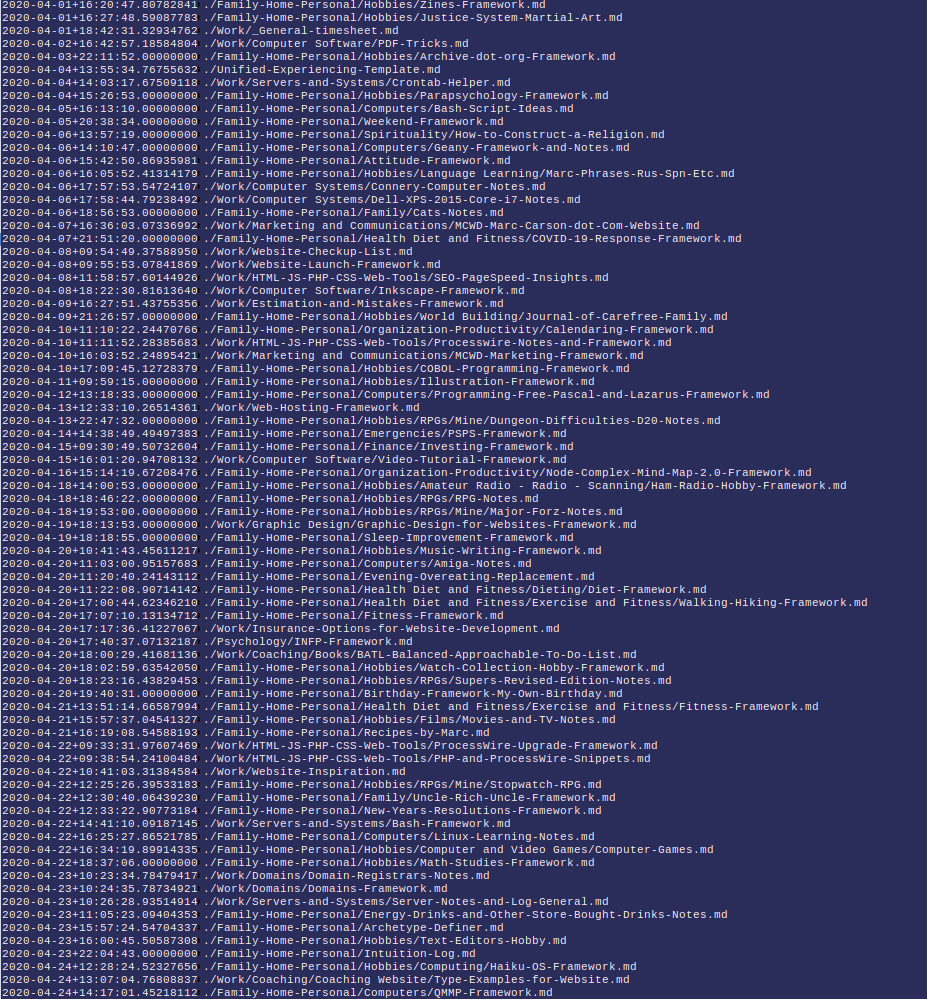
Some of these represent big edits that took a lot of time, and some represent little updates here and there, like applying the Unified Experiencing Template to a bunch of loose notes.
As of right now the total number of these files is about 900. I may cross over 1,000 soon, but I also want to be careful: Quantity is not quality. I’ve also combined quite a few frameworks since 2017.
Also, many of these are really low-quality in terms of objective information. They’re mostly subjective, which is the point—they’re about me learning stuff, not you or anybody else. You know that voice that tells you, “you probably already know this stuff?” You’d probably be right in a lot of cases. However the real treasure to me is in factors like:
- Where I left off with my last experience in this area
- Where I want to go next with this interest, hobby, or general framework
- Maybe some resources, like links I don’t want to have to search for next time
- The history of me and a particular interest—when did it start? And why?
The older I get, the more important that sort of thing becomes. This is a broad support base for a very broad set of interests. And those interests give me energy & good vibes.
It’s fun to re-open some of the old frameworks, and see what I’ve built up over time, too. In my RPG frameworks, it’s easier than ever to pick up an old campaign and keep playing.
Filed in: Productivity /120/ | Therapeutic Practice /148/ | Energy /121/ | Interests /112/
How I Write 100 Blog Posts a Year (5-year Blog Anniversary)
Friday April 24, 2020*
We’re coming up on the 5-year anniversary of this blog! It started back on May 5th, 2015. I’m pretty proud of how things have gone during that time.
I originally started the blog as a place to park my studies as I explored my Thinking side. In fact, the original title of the blog was “Marc Thinky.” Prior to that, Friendlyskies.net was mostly an exploration of my visual arts-related hobbies.
My first blog posts here were just me reading books and taking notes. I still do that sometimes. I used a lot of bullet points. I still do that. I like bullet points, maybe too much.
Over time, I have widened my range here on the blog to also include many of my own thoughts, feelings, and perceptions, as opposed to the thoughts of other people.
I don’t get a ton of feedback on the blog—my mailbox certainly doesn’t overflow with blog-related emails, but I do get a lot of those emails in bursts. Some of you write me to let me know what you’re thinking about, what you’re up to, and others write with questions or comments on new posts.
About 20% of the contacts are people who are either married to or are dating INTJs.
“Some facts about that shit”
- When someone writes and tells me they’re married to a “bog-standard INTJ” or similar term, I feel bad for them. They don’t mean “bog standard as in the world’s most awesome person,” but quite the contrary, rather something to be pitied. And I get it—any personality type can be “bog standard” and that comes with a LOT of downsides. This is also why Jung wasn’t super happy with the idea of MBTI-style personality types: They can easily leave the “level of personal development” question on the table, as people celebrate their inflexibility by parading their core personality type.
- Sometimes people absolutely dump on me. I’m OK with that. I can’t always give enough of myself to reply in full though. Some of these people are really suffering under a lot of stress. They’re all over the map. They know it, I know it. It bugs me that I can’t be both as graceful AND effective as I want with these people, but I do my best.
- Sometimes it is very clear that people who write in are paired up with absolute jerks who want to think really highly of themselves but who are so, so not worth the time and energy. That much is probably obvious to everyone except their spouse or boyfriend or friend who wrote in, and who is trying to figure out how to move up and on. There is not usually much I can do about this, or at least it feels that way—and that is frustrating to me.
- This last item has helped me to be a more humble and circumspect person, I think. I hope. Certainly writing in general has helped with that.
Others have written in, or left comments that are extremely unkind to yours truly. Comments about my writing style (what writing style?!), the kind of guy I seem to be, my photo, my face, or whatever.
Some of these comments admittedly left me enraged. But I try to balance this experience with the knowledge that a lot of people surfing the net are really unhappy with themselves, and they tend to project a lot when given the opportunity.
About the Writing Pace
My current blogging pace is about 100 blog posts a year, and it’s been that way for a while now. It’s not exactly a world record, but it’s a big deal for me. And I like to think that a lot of my blog posts land a bit above the “quantity” bar, in “quality” territory.
What makes it work
As far as I can tell, here’s how I went from “not many” blog posts a year to 100 a year:
- I learned something important: I’m more prolific if I don’t organize first. I try not to front-load a blog post with a bunch of unnecessary stuff. I vomit out one informational thing, then a bunch of others. Then I go back and organize afterward.
- The “Draft” feature of my blog is like a “Never Publish” time bomb. If I don’t move from Draft to Published within 5-6 hours, there’s a good chance I’ll never go back and hit Publish, because my mood changed, or I ran out of time, or whatever.
- Sometimes I invent new stuff while I’m writing. Draft Version: “How the Heck Do I…” and Final Version: “Here’s How I Learned to…”
- I recognize, and use, blogging as a psychological support activity for myself. It’s a nice outlet. It’s me providing answers, but it’s also me opening up new questions. I in fact there’s a good chance that my pace here will accelerate. I already write at least 3-5x more than I blog—in my journal and other personal files.
- I found a way to keep executing on blog-wide changes I’d like to see. Leaving blog posts aside, other aspects of the blog are continually changing. This is really, really important. It’s what keeps me liking the place—watching it change and improve in lots of little ways. For example, I update the sidebar at least once every week or two, and in the last couple weeks I’ve added about 20 new music links to the music database.
- Sometimes people ask me to write about a given topic. Or they’ll ask me about something that’s worth writing about.
- Something I wrote a long time ago may trigger me! So I feel the need to clarify, or expand upon what I wrote. More blog posts ensue.
- This blog has a history now, and I value that more than I used to. Even if it had the shittiest reputation on the planet, this place is my own little thing and I like it. Every day it becomes more like the kind of blog I like.
My publishing method
Here’s the secret sauce! This is what comes natural to me:
- Put something really basic out there, lacking all details but “big-picture good”
- Hit “Publish”
- Edit like crazy for a day or two
- Reorganize it a bit so it flows logically
- Add examples, if needed
- Add exercises, if needed
- Add an outro
- Cross-link it / Reference it elsewhere, because it wasn’t so bad
- Go back and polish it up a bit more because
- you just linked / referenced it again, and there might be typos
- you think you can improve on it
- Wait until you get triggered again, and repeat
My real secret
Finally: A lot of this is also supported by my back-end “bat cave” writing, which always comes first. Many of my blog posts come straight from my journal. The tools I share here are tools I use in real life.
Anyway
It’s been a pleasure to share my work with you guys and I look forward to writing more.
And: Happy Birthday, INTJ Blog!
Filed in: Thinking /71/ | Essays /53/ | Productivity /120/ | Energy /121/ | Therapeutic Practice /148/
I Upgraded my Communications
Friday April 24, 2020*
…and updated the How to Contact Me article to add context.
The original version did feel a little bitchy. And there’s this bitchy part of me that has a really on/off voice, and I’m working on that.
Well that’s not true. Mostly I’m alternately amused by it and worried that I might offend someone. But I’m “working on it” in the sense that I’m staying open to revising my practices by moderating the bitch level.
In fact, objectively-experienced Marc probably needs a voice that’s more consistently bitchy, but at a low volume level when it comes up. Something like that. (The number of people who know me in person and consider me bitchy is definitely low, if it’s even a number at all…am I sad about that? Why does it feel like a double-edged sword?)
Anyway I kind of like giving attention to my bitchy parts. They’re just more open to fun in a way that easily transcends the word “bitchy,” but bitchy is a funny word to throw around. Funny because we’re all INTJs, and our composure is so over-the-top as a group. Say it with me now, bitches!
Ehhhh, that sounds too much like Joe Rogan. Oh well.
By the way, this very morning, bitchy-voice gave me a great podcast idea. And it has been a while since I made a podcast…
…in fact, quite often if I stop doing something that I once enjoyed, the reconciliation and re-start has a lot to do with listening to the bitchy voice. Hmm….
Filed in: Feeling /64/ | Therapeutic Practice /148/
From Awareness to Integration: The A2i Loop, A Generalized Problem-solving Tool
Friday April 24, 2020*
I’ve been thinking—what is an awareness-first problem-solving process that I can really recommend? It should be one that integrates awareness as a starting factor, and then builds on top. It also needs to be a process that gives the awareness full credit for what it can do, while suggesting follow-on steps. Awareness may be key, but it’s also not everything.
I wasn’t really happy with existing paradigms (and I don’t have time to go researching every problem-solving paradigm out there, that’s for sure), so here’s my own shot at it.
These are the steps in what I’ll call the A2i Loop:
- Awareness
- Observation
- Analysis
- Execution
- Integration (then back to the start)
Here are some of the major inputs at various stages of the loop:
- Awareness <— Calls upon Passive-Energetic Inputs
- Observation <— Calls upon Sensational Inputs
- Analysis <— Calls upon Logical Inputs (Typically starting with organization of information)
- Execution <— Calls upon Intuitive Inputs (Conceptualization)
- Integration <— Calls upon Executive-Energetic Inputs (Concretization)
Integration is a step which is concerned with change-energy—you’ve executed and now there’s this brand new outcome / identity / form / format to integrate into your consciousness. It changes your very state of being. It often ushers in a reflective energy, along with a new form of prospective transcendence-energy in which your “self” or even team identity has changed. This in turn becomes part of, and affects, your new awareness…
Documenting the changes or new knowledge as part of the Integration step can greatly enhance results from using the A2i Loop. If you want to get the most out of the A2i Loop, you should be able to observe yourself capturing new knowledge and integrating it into new pursuits.
The Integration step will generally be more effective, the more the integrated knowledge or experience can be interpreted as flexibly as possible in terms of its scope. If you can play with new ideas and learning takeaways, and take a multiple-model approach, you are more likely to gain fast and effective results from the A2i Loop.
Personality Ramifications?
While this isn’t meant to “fit” any given personality type model, I’d guess that EJ personality types tend to be skilled in the final steps E & I. IP types would tend to be more skilled in the initial steps AOA (I’ll call the second A “A2”).
IJ types (like us INTJs) would then need to build gap-bridging competence through A, O, A2, and E. EP types would need to build gap-bridging competence from I through A2.
In general though, being of a type wouldn’t automatically make one more competent than someone else in any particular area. For example, quickly drawing on the intuition to execute on a problem doesn’t say much about the quality of the conceptualized solution; some qualitative work on the imaginative-iterative process is probably a good idea for most people.
Compared to OODA Loop
One concept of which I was aware going into this was the OODA Loop. OODA never caught on for me, I think in part because it’s mostly hard, and not as hard and soft as it could be. Here’s how I see the major differences:
- A2i directly integrates the “soft” concepts of feelings, energy, and the intuition. (These are relevant even in a military context!)
- A2i Begins with Awareness, which in my view is different (often much different) from Observation. Cultivating awareness is a specific activity which can even serve its own ends.
- A2i Ends with Integration, which yields a deeper and longer effect than “Action,” especially if integrated with recall. Capture of the Integration step is also a “soft process” which can yield results like the activation of a reward system, a celebration, etc.
- A2i is effective while being simpler than OODA. It also opens up a more elegant and realistic solutions-oriented process, if I do say so myself ;-)
A Basic Exercise
- Think of a problem of which you’ve recently become aware.
- Write down your observations of the problem, either as you can recall it, or as you actively observe it, or both.
- Bring some organization to the observations. Can they be organized by time, location, level of rest, people involved, etc.?
- What does your intuition or imagination tell you would make a good thing to try or test next, in order to help solve the problem?
- What happened when you tried it?
- You are now a changed being—and perhaps your problem set has changed as well. Start again with your new pool of experience and energy inputs. Of what are you now more aware than you were before? Or how has your awareness changed?
Update, 2020-09: The AOAEI Loop has been renamed as the A2i Loop.
Filed in: Ti /30/ | Therapeutic Practice /148/ | Control /112/ | Te /36/ | Productivity /120/ | Publications /44/ | Intuition /63/ | Energy /121/ | Sensation /40/ | Thinking /71/
Daily Journaling Template Updated, 2020-04
Thursday April 23, 2020*
Today’s journaling template update includes a couple of non-minor updates:
- Health metrics (if it’s healthy for you to track those)
- A timestamp prefix tip for tracking DaySCOR rating changes throughout one’s day
- …plus various minor updates to wording.
As always:
I continue to use this template myself, and find that it has become one of my most useful tools for near-instant stress relief. Over time, this habit also tends to build a pool of documentation which can be used for knowledge capture.
Filed in: Therapeutic Practice /148/ | Technology /41/ | Te /36/ | Coaching /27/ | Feeling /64/ | Fi /35/ | Thinking /71/ | Energy /121/
From Experience to Mastery: The FE2M Framework
Thursday April 23, 2020*
This framework (I’ll call it FE2M) is meant to assist in bringing questions of competence to your conscious awareness. It can add more decisiveness or direction to your practice of, or experience with, a thing.
The “thing” in question could be a hobby, a type of food, a form of physical self-care, or many other things. This can also help firm up individual goals or new year’s resolutions.
Experience Level
Pick a level to use as a prefix.
- x0 = I haven’t tried it yet. I may be enjoying thinking about trying it.
- x1 = I gave it a basic look-over, or a basic read, and a try.
- x2 = I attempted to do some real work / real X while applying it. I have spent somewhere over 20 hours or have had something like 50+ sessions with this thing. I may have made big progress.
- m0 = I am maintaining a practice of this which keeps me sharp. I made some notes or otherwise organized what I have learned, and what I need to learn about it, or try, next. I have at least a medium-term goal of where to get to with this, in my mind’s eye and on paper.
- m1 = I have done it / used it enough to know it inside and out. I know not only its common problems; I also know many workarounds. I could easily teach it to others, up to the intermediate level, without further study. I am very flexible in its use / application / integration.
- m2 = I have done it / used it enough to build my own methods or ideas onto it and adapt it or change it when needed. Such methods are also useful to others. I could teach it at the advanced level without further study. I can teach multiple philosophies or theories of the thing. This can be plainly seen from my public practice or demonstration of my skill. According to existing, objective measures agreed upon by people neutral to or unknown to myself, I am at this level.
- m3 = I have taken the practice of the thing well beyond what others would. I have integrated it into other practices to a degree rarely seen. I am an elite expert at it—there are perhaps less than one thousand people at this level in the world. This fact has been recognized by multiple objective third parties (people who don’t know me or have a stake in my practice, and who are also experts).
Quite intentionally, m2 and m3 levels get into starkly objective conditions. For example, you may not be able to be an m3 artist without having won multiple, extremely exclusive art awards, and having been interviewed by those outside the field like journalists who live on the other side of the planet and otherwise wouldn’t know you, except that your art is appearing on everyone’s T-shirts in their country (just as an example).
This also gets at the importance of specificity and the niche—how many thousands of great “artists” are there, vs. the number of blind tattoo artists? And yet, with the objectivity factor also taken into account, things cannot be ridiculously specific, can they? Otherwise there may be no one who cares enough to rate your expertise. So this may point at the need to do more thinking about one’s practice or specialty (if desired).
Not everything needs to go to an m3, and the point of the framework is only to assist in establishing balance or momentum where desired, rather than encourage you to literally level up on everything. This is why the Energy Resource Rating is included…
Energy Resource Rating
In order to capture the emotive / soft side of the practice, one of the following suffixes is added to the overall level.
- _0. Thinking about this completely de-energizes me. I’m burnt out and really hate this.
- _1. I don’t like it at all. When others discuss it, I’d rather talk about other things.
- _2. I’m not happy about it, or my practice of it.
- _3. I’m not interested in it at all.
- _4. I’m pretty ‘meh’ about it. Generally disinterested.
- _5. I’m looking forward to more time with it.
- _6. I’d rather spend more time with it than many other good things right now.
- _7. I’m excited to see what I can learn next.
- _8. It makes me exceedingly happy to think about doing this again.
- _9. I cannot contain my excitement to get to the next level with this thing.
(If in doubt, always round down. For example, a 4.5 would be a 4.)
For ratings under 5, also specify…
- a. I am not sure why I am at this level. I may need to think or write about my thoughts, if I’m to find a balance point with this thing.
- b. I don’t see a reason to progress with it. I may need to apply more nuance in how I experience or think about it.
- c. I don’t see a way to progress with it. I may need to do more experimentation, find new ideas, or talk to others.
Examples
Here are some personal examples:
Eating Squid: x1_4c. I have tried it quite a few times, but I may just need to get used to the texture via exposure. I’m also not sure if there might be a dried squid flavor or variety that I like more than others. I may need to research this.
Running for Fitness: x2_3b. I enjoyed it in the past, but these days—no thanks. I see no reason to take it further. One of my doctors gave me a pamphlet on roller-blading instead, saying he’d prefer to see less joint damage in sports.
Geany Text Editor: m1_6. I keep a file on my changes, am proud of how flexibly I can use it, and I really enjoy my time spent in this editor.
Watercolor Illustration: m1_4a. I’m much better at this than I used to be. Still, I’m sensitive to the fact that my practice feels disorganized, despite my experience level. This is sapping my energy because restarting the practice starts to feel like starting from square one. I can see I need to start on that organization, at the very least.
Tips
- Retracement: Go back a couple levels and act as if you are on that level. A disorganized m1 may need to go back to m0 (See Watercolor Illustration example, above)
- …I’ll add other tips here as the practice develops…
I hope this is helpful to some of you!
Filed in: Therapeutic Practice /148/ | Thinking /71/ | Goals /52/ | Energy /121/ | Publications /44/ | Productivity /120/ | Te /36/ | Control /112/
Energy Drinks: My Experiences and My Favorites
Thursday April 23, 2020*
On occasion I really, really enjoy an energy drink. For years I thought these were basically a tool of Satan himself (I literally thought that, in case you’re not aware of my hard-core religious upbringing).
Since that time, much to the contrary, I’ve found that energy drinks are:
- Usually pretty tasty
- Fun to try
- Nice to look at (the can designs)
- Pleasant delivery mechanisms for caffeine
How I Avoid Overdoing It
Since I started using caffeine, my methods have evolved. As a caffeine user I’d guess I’m a bit of an outlier, because I use caffeine in a structured, planned-out way. I’m more likely to take caffeine in tablet form, at a planned time, than as a drink.
My to-do list often shows entries like, “2 p.m., take 100mg caffeine,” which is an F / Circle activity if you use Task BATL.
To me, an energy drink is more like a fun treat, like eating an ice cream cone.
Energy drinks usually contain anywhere from 90 to 200 milligrams of caffeine. In my opinion this is pretty lightweight. Typical store-bought caffeine tablets are 200 mg. each.
I’ve been supplementing with caffeine for a while now, and my body seems to know when it would benefit from caffeine. When I was just starting to try it, I would get migraines because of caffeine use during productivity exhaustion. I didn’t realize that there are specific times when caffeine use will get you amazing results, and other times when even if you “need” the productivity, caffeine is not going to help as much as other methods and it might even cause you pain or harm.
When Caffeine Really Helps
According to my research, caffeine helps me most when:
- Starting my day (especially after 7.5 to 9 hours of sleep)
- Working out / getting cardio
- Going hiking
- Resuming work after taking a nice nap
- Returning from the dentist (more on that below)
- Driving on a road trip
- Making heavy use of the intuition, especially extraverted intuition
I don’t think I’ve ever gone over 1000mg caffeine in one day, but that would be a pretty extreme day, and most of that would come from caffeine tablets, not energy drinks.
I also don’t really get addicted to things so I’m the wrong guy to ask about consistently overdoing it, or breaking the habit. But if you are getting more than 500 to 700mg of caffeine a day, for god’s sake I hope you are finding some downtime to be gentle on yourself.
I do keep records on my energy drink hobby, for the heck of it (or for the learning of it, which is fun to me). As of right now I enjoy about two to three energy drinks a month, on average.
My Favorite Energy Drink
My all-time favorite flavor & brand is a tie, between Original CELSIUS Sparkling WildBerry and Original CELSIUS Orange. (No affiliation, I just like their products)
- Visually: I love the can shape, and I like how they colored the top of the can black.
- Taste-ually: The flavors are really pleasant and light. Not even close to overbearing.
- Calorie-ually: 10 calories total—great if you are on a cut or otherwise aiming for a caloric deficit. But “low calorie” is also code-word for “light flavor” which is another aspect I like.
One of these, accompanied by a donut, is probably one of my favorite breakfast meals of all time.
Also, if I have an appointment at the dentist, I try to pick one up afterward, as both a reward for visiting the dentist and a method of making any pain-numbing anesthetic effects wear off more quickly. The caffeine works really well at that, for me.
Note: CELSIUS is a “Fitness Drink,” but to me it’s basically an energy drink. Still, the formulation seems different from the average energy drink, so maybe there’s something to it—or maybe it’s just marketing speak. Not sure.
Another brand I like is Adrenaline Shoc, especially the Frozen Ice flavor.
My Least-favorite Energy Drink
Last year I bought a $1 energy drink at a local store, just to test it out while spending a weekend camping. I think it was supposed to be a copy of 5-hour Energy, as it came in a small bottle and similar packaging.
That drink had the most powdery, bitter, taurine & caffeine taste I think I’ve ever experienced. It was so gross that I almost gagged and reached for anything nearby to eat, drink, and cover up the taste.
Filed in: Energy /121/ | Sensation /40/ | Fitness /31/ | Therapeutic Practice /148/ | Interests /112/ | Openness /49/ | Intuition /63/
Whole Productivity
Thursday April 16, 2020*
Edit: This blog post turned into its own productivity system. You can learn more about how it works.
If “productivity” means “getting things done,” we need a new concept within productivity to start addressing a broader set of aspects that matter.
The concept of “getting things done” is way too exclusive. It too easily works against the grain of human psychology. When you fail to “get things done,” you are being “uproductive,” and you reach for labels like “procrastinator.”
There’s always something a person is not “getting done.” So why keep pushing this button? It’s madness. Meaningless madness.
Productivity, given such limited definition, easily becomes a baroque guilt mechanism, almost like a medieval torture device. A quiet killer, difficult to move around in, and excruciating.
Here is a broader set of the aspects that matter:
- Getting things done
- Getting things felt
- Getting things out
- Getting things up
- Getting things said
Each one of these aspects can enable “Getting things done,” in a way that focusing only on “Getting things done” can’t.
We need tools that help us to stop torturing ourselves.
I’ll call this set of things “Whole Productivity” for now, and return to it later.
Filed in: Productivity /120/ | Control /112/
For Those Detachers, For Us, Detachers, and for You, Detacher
Thursday April 16, 2020*
Detacher: The opposite of an addict.
- Quitting bad things, and making big changes in my life, are my gifts!
- But also in a negative way
- Damn, I went off my medication again
- Not the one that saves my life
- But the one that I liked
- Why would I detach from that?
Why would I detach from…
- Something I like?
- Someone I like?
- The world?
I can see everything from here…from the outside. Why do I feel so supreme,
- And yet so troubled?
- I wonder if I could ever detach from my flesh and blood. The things I love…just
- Not in my attention anymore?
- Or if in my attention, somehow not…seen? Done? Anymore.
This is just a sketch of the detacher, especially when they realize that detachment is not just being “great at not being an addict.” I’ve also shared some ideas for detachers if they may be useful.
Note: Some have contacted me to point out that I should correct myself—They tell me that the opposite of “addiction” is “love”, or some other word, depending on their studies or background.
Please keep in mind that those are simply terminologies used by different models/systems, and the detachment model above is what I consider another one for the pile. It has been my experience that it’s usually better to have & use multiple models, as opposed to just one.